


The moment people see it move
It feels wrong to trust a building to something that swings.
Visitors standing on the observation deck of Taipei 101 sometimes catch it in motion—a slow, heavy shift of a massive gold sphere hanging in open air. It doesn’t crash. It doesn’t shake wildly. It just glides, almost calmly, as if it knows something the rest of the building doesn’t.
That quiet movement is the whole point of the Taipei 101 damper.
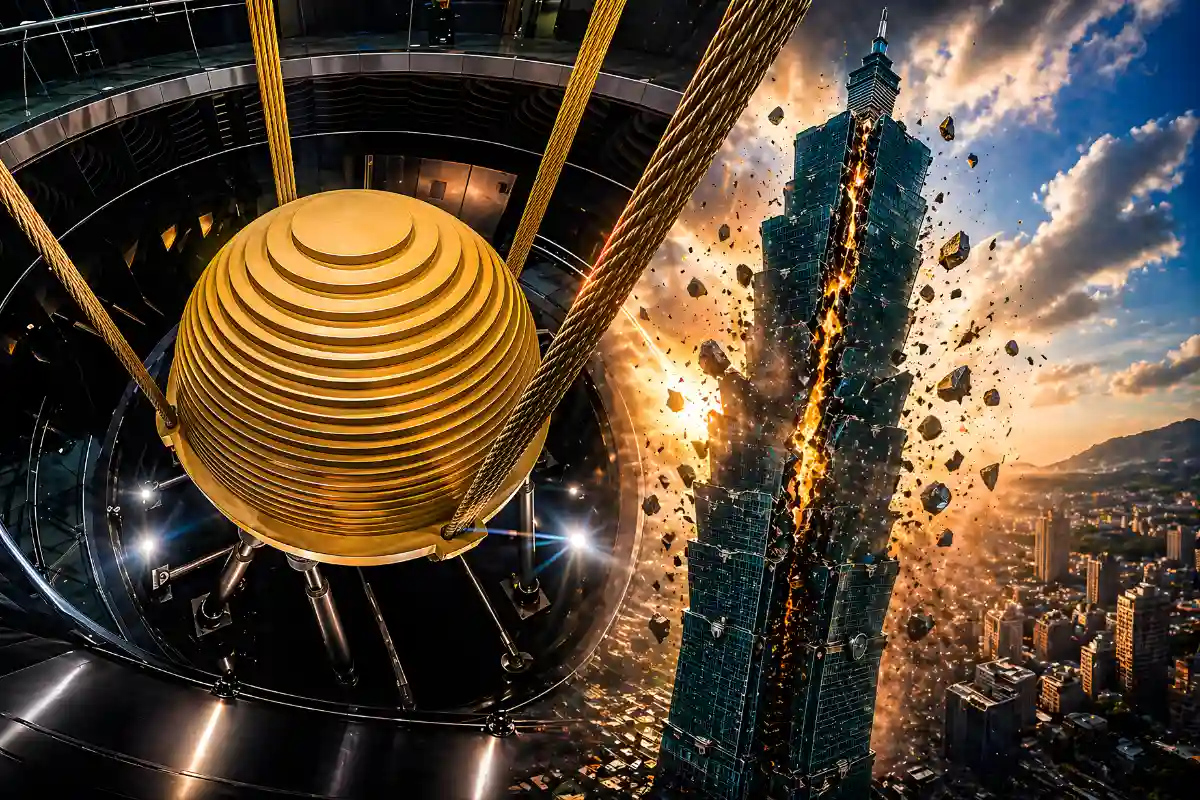
The 660-ton steel ball, suspended between the 87th and 92nd floors, is designed to move when the tower moves. When typhoon winds push the skyscraper or an earthquake sends vibrations through it, the damper swings in the opposite direction. That counter-motion reduces sway and keeps both the structure and the people inside stable.
The one thing most people don’t know
The building is supposed to move.
That’s the part most visitors get wrong. Skyscrapers like Taipei 101 are not rigid. They are built to flex, especially in places like Taiwan, where both typhoons and seismic activity are part of life.
Without the Taipei 101 damper, the tower wouldn’t suddenly collapse. But it would sway more—longer, wider, and more violently. Engineers estimate the system can cut peak motion by up to 30–40 percent, a difference that directly affects how safe and livable the building feels during extreme weather.
For the people inside, that difference is not subtle.
It’s the line between mild discomfort and motion that feels like a slow, relentless drop.
What the Taipei 101 damper actually is
At its core, the Taipei 101 damper is a tuned mass damper—a simple idea scaled to an extreme size.
It’s a steel sphere about 5.5 meters (18 feet) across, weighing roughly 660 metric tons, suspended by eight thick steel cables. Below and around it are hydraulic dampers that absorb energy and control how far it swings.
The system is “tuned” to match the natural frequency of the building. That means when the tower begins to sway, the ball moves at just the right timing to counter it.
No electronics are needed to “decide” what to do.
Physics handles it.
When wind pushes the building one way, the ball lags slightly and swings the other way. That opposing force reduces acceleration—the part humans feel most.
That’s why people describe it as a “giant pendulum,” though its role is closer to a stabilizer than a simple weight.
Why it matters in daily life
For most people inside Taipei 101, the damper is the reason they don’t notice anything at all.
Office workers can sit through a storm without their desks shaking. Visitors can walk across observation floors without feeling like the ground is drifting. Elevators, glass panels, and interior systems all experience less stress.
Without the damper, even normal high winds could cause noticeable motion. Over time, that would mean:
- More strain on joints and connections
- Higher risk of cracks in walls and façades
- Increased maintenance costs
- Greater discomfort for occupants
And during extreme weather, the difference becomes more serious.
People could feel prolonged swaying strong enough to cause dizziness or nausea. Not structural failure—but not something anyone would want to experience hundreds of meters in the air.
The limits—and the doubts
No system like this removes risk entirely.
The Taipei 101 damper reduces motion, but it does not stop earthquakes or wind forces. The building still relies on its core structural design—reinforced concrete, steel framing, and deep foundations—to handle major events.
Cost is also a factor. Systems like this add millions to construction budgets and require ongoing inspection and maintenance.
Some engineers have argued that newer towers rely more on aerodynamic design—shaping the building itself to reduce wind forces—rather than massive internal weights.
For example, Shanghai Tower uses a twisting form along with multiple damping systems to manage sway.
Even so, tuned mass dampers remain one of the most reliable solutions for supertall buildings, especially in regions with strong environmental forces.
The human side of the machine
There’s a reason Taipei 101 made its damper visible.
Most buildings hide systems like this deep inside their structure. Taipei 101 turned it into a feature. Visitors can stand just meters away from the massive sphere, watching it move in real time.
It even has a mascot—“Damper Baby”—turned into souvenirs and branding.
During Typhoon Soudelor in 2015, the damper reportedly swung over a meter, a rare moment when its purpose became visible to the public. Videos of that movement spread widely online, with viewers reacting in equal parts awe and unease.
A Reddit thread discussing the system drew hundreds of comments, many circling the same idea: people were surprised that something so simple—a swinging mass—could stabilize one of the tallest buildings on Earth.
Others joked that the entire tower felt like “a controlled fall that never finishes.”
That reaction says more about perception than engineering.
Why people can’t stop talking about it
The Taipei 101 damper hits a nerve because it flips expectations.
A billion-dollar skyscraper, built with advanced materials and precision engineering, depends in part on something that looks almost primitive: a giant hanging ball.
It feels like a workaround, not a solution.
And yet, it works.
That contrast—between high-tech ambition and simple physical principles—is what keeps the story circulating. It turns an invisible safety system into something people can picture, question, and even doubt.
There’s also a deeper tension: trust.
Would you feel safe knowing your building relies on a swinging mass to stay steady?
Most people don’t realize that many tall buildings use similar systems. They’re just hidden.
Taipei 101 chose not to hide it.
Back to that quiet movement
The sphere doesn’t rush. It doesn’t panic.
It moves slowly, deliberately, like it’s absorbing something the rest of the building doesn’t want to feel.
And when the wind dies down, it settles again—almost perfectly still, waiting for the next push.
The Taipei 101 damper doesn’t stop the forces acting on the tower.
It just makes sure those forces don’t get the last word.
The next time it swings, it won’t be a failure.
It will be proof that it’s doing exactly what it was built to do.