


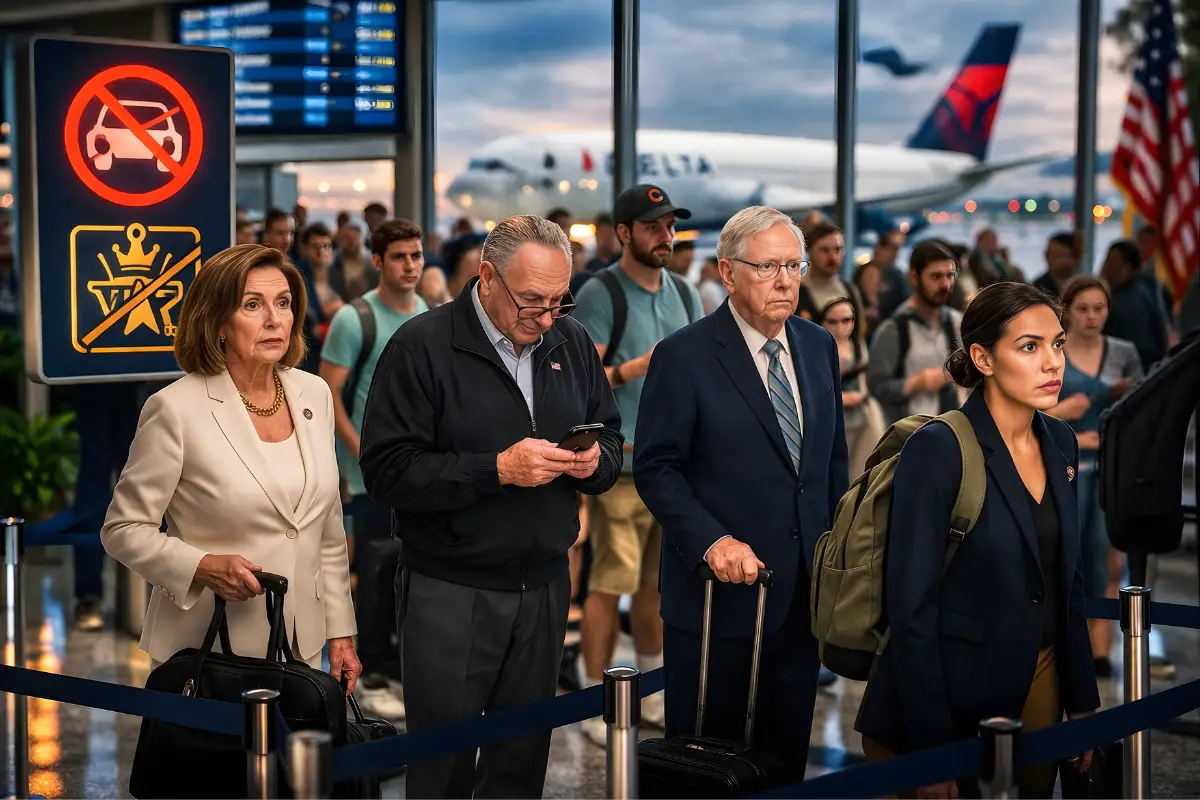
The line barely moves, and the clock doesn’t care.
At one of the busiest terminals in the country, the kind where people usually rush past each other with purpose, something felt different. The usual quiet separation between “priority” travelers and everyone else seemed to vanish. And during these government shutdown airport delays, even people used to skipping lines found themselves standing still.
That’s the moment driving the story: lawmakers—people who often travel on tight schedules with added support—are now moving through airports like everyone else, slowed down by the same long TSA lines affecting millions of passengers.
The immediate question most readers ask is simple: are lawmakers really being forced into regular airport lines?
The answer is more nuanced. During a government shutdown, staffing shortages—especially within the Transportation Security Administration (TSA)—reduce the availability of extra services, including some VIP-style assistance. The result is not a targeted policy, but a system stretched thin enough that priority handling becomes harder to maintain.
A Traveler With No Shortcut
On a recent weekday morning, a congressional staffer in his early 40s, traveling out of Atlanta, described arriving two hours early—and still feeling late. He had a meeting scheduled in Washington, D.C., one that usually allows little room for delay.
This time, there was no escort, no quiet side entrance, no quick pass through security.
Just a line.
“I travel often, but I’ve never had to plan like this,” he said, noting that what used to be a predictable airport routine now feels uncertain.
He stood behind families juggling carry-ons, business travelers checking watches, and first-time flyers trying to understand the process. No one moved faster than anyone else.
The Numbers Behind the Delays
Government shutdown airport delays are not new, but the scale can be significant.
During the 2018–2019 shutdown—the longest in U.S. history—TSA reported absentee rates as high as 10% at major airports, according to data from the Department of Homeland Security. Agents were required to work without immediate pay, leading to increased callouts and strain on operations.
That translated into real wait times:
- Security lines stretching beyond two hours at peak times
- Reduced staffing at checkpoints
- Fewer available resources for non-essential services
For travelers, that means more time, more uncertainty, and fewer options.
For officials who rely on tight schedules, it means something else: lost control over time.
Why the System Slows Down
The core issue isn’t airlines alone. It’s the structure of airport security in the United States.
TSA is a federal agency. When the government shuts down, its funding and workforce stability are directly affected. While agents are considered essential and must report to work, delayed pay creates pressure that shows up in attendance and morale.
Airlines like Delta still operate their own premium services—such as concierge check-in or escort programs—but those rely on coordination with airport and security staff. When TSA is stretched thin, those add-on services become harder to deliver.
Priority shifts.
Basic security first. Everything else second.
A TSA spokesperson during the previous shutdown told CNN that the agency remained focused on “maintaining security effectiveness,” even as wait times increased. That trade-off is key: safety stays intact, but speed suffers.
And when speed suffers, every traveler feels it.
The Debate Playing Out Online
The reaction online has been immediate—and divided.
On platforms like Reddit and X, posts about lawmakers experiencing standard airport delays have drawn thousands of comments. The tone leans heavily toward frustration mixed with a sense of irony.
One widely shared comment read: “If they had to deal with this every trip, things would change real fast.”
Another user wrote about waiting nearly three hours at a major airport, adding that “no one gets special treatment when the system breaks.”
That sentiment—fairness through shared inconvenience—has fueled much of the conversation.
But not everyone agrees.
Some argue that priority travel for officials isn’t about privilege, but efficiency. Elected leaders and government staff often operate on tight timelines tied to policy decisions, hearings, and national matters.
Delays don’t just inconvenience them—they can disrupt schedules with broader implications.
Still, the optics matter.
And right now, the image of lawmakers standing in the same lines as everyone else is resonating.
When the System Feels Personal
Air travel is one of the few systems almost everyone interacts with. It’s routine, but it’s also unpredictable.
You pack carefully.
You arrive early.
You hope for a smooth process.
Then you wait.
And wait.
Government shutdown airport delays take that shared experience and amplify it. They strip away the small efficiencies people rely on—whether it’s TSA PreCheck moving slower than usual or premium services quietly disappearing.
For many travelers, this isn’t new.
It’s just more visible now.
Because the people who help shape policies are going through it too.
The Moment That Sticks
Back in that terminal, the line eventually moved.
Shoes came off. Bags went through scanners. People gathered their belongings and moved on.
The staffer made his flight—but barely.
And for the first time in a while, he experienced something most travelers know too well: planning carefully doesn’t always mean moving faster.
So the question lingers, not just for lawmakers but for anyone who’s stood in a slow-moving airport line:
If this is the system everyone depends on, what would it take to make it work better—for everyone standing in it?