
There’s a kind of silence that hits right after everything goes wrong.
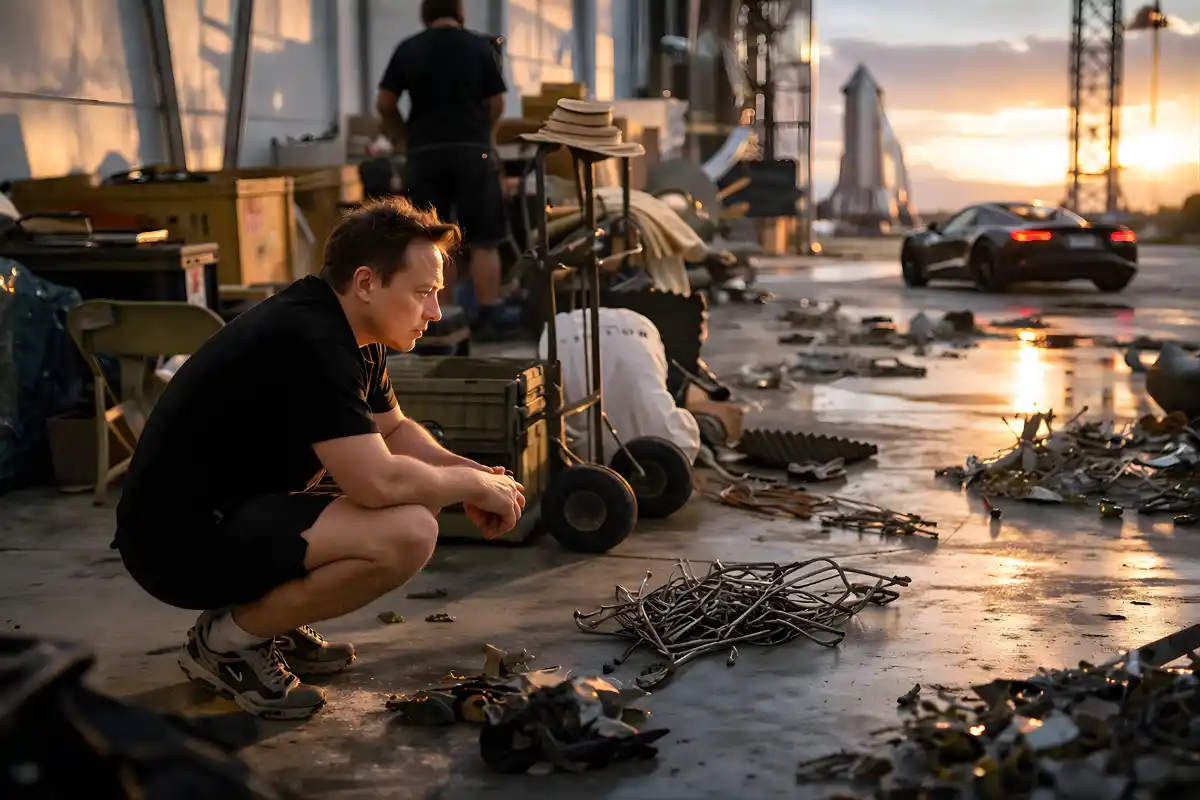
In the Elon Musk failure story, that silence came after fire, debris, and another failed rocket falling back to Earth. Inside a quiet factory, Musk sat still, watching months of work and millions of dollars disappear in seconds.
No applause. No headlines yet. Just the weight of one more failure.
The Scene
The room wasn’t dramatic. No flashing lights, no chaos. Just parts, tools, and a few people trying to process what had just happened.
Elon Musk was there, sitting low, elbows on his knees, staring at the ground.
Another rocket had failed.
It was 2008, and this was the third time SpaceX had tried to reach orbit with its Falcon 1 rocket—and failed. Each attempt ended the same way: something broke, something misfired, something didn’t separate the way it should.
Each failure cost tens of millions.
This one felt heavier.
Who + Why Now
The Elon Musk failure story keeps resurfacing because it captures a moment most people never see—the point where success almost didn’t happen.
Before reusable rockets and billion-dollar contracts, Musk was just a founder running out of money.
He had already poured over $100 million of his own money into SpaceX, funds he made after selling PayPal. At the same time, he was also trying to keep Tesla alive during one of the worst financial crises in decades.
Both companies were close to collapse.
And by late 2008, Musk wasn’t just risking failure.
He was running out of time.
The Full Story
SpaceX launched its first Falcon 1 rocket in 2006. It didn’t make it far. A fuel leak caused a fire, and the mission ended early.
They tried again in 2007. This time, the rocket got further—but the engine shut down before reaching orbit.
Two failures.
Expensive ones.
Still, the team pushed forward. Musk believed fast iteration—build, test, fix, repeat—was the only way to compete in an industry known for slow, cautious development.
Then came the third launch in August 2008.
This one looked promising at first. The rocket lifted off cleanly. For a moment, it seemed like everything might finally work.
Then the stages failed to separate properly.
Another failure.
Three in a row.
At this point, most companies would have stopped. Investors were already skeptical. The aerospace industry didn’t take SpaceX seriously. Some saw it as an ambitious experiment that had run its course.
But Musk didn’t shut it down.
He couldn’t afford to.
He decided to fund one more launch.
One last attempt.
That decision came with real risk. Musk later said he was close to running out of money personally. Reports from that time suggest he had to borrow money for living expenses while trying to keep both SpaceX and Tesla afloat.
He split what little he had left between the two companies.
It wasn’t a safe move.
It was a desperate one.
On September 28, 2008, SpaceX launched Falcon 1 for the fourth time.
This time, it worked.
The rocket reached orbit.
For the first time in history, a privately developed liquid-fueled rocket had done it.
That one success changed everything.
Just a few months later, in December 2008, NASA awarded SpaceX a $1.6 billion contract under its Commercial Resupply Services program. That deal gave the company the stability it needed to survive—and grow.
The near-collapse turned into a breakthrough.
All from one last try.
Public Reaction
Years later, the Elon Musk failure story spread widely online, especially on platforms like X (formerly Twitter), Reddit, and YouTube.
On Reddit, threads discussing the story often draw hundreds of replies. Some focus on the risk, others on the money behind it.
One common sentiment shows up again and again: “Most people don’t get four tries.”
The tone is mixed.
Some people see the story as proof that persistence pays off.
Others point out that Musk had access to resources most founders don’t, which made it possible to keep going after repeated losses.
On X, short posts about the failed launches and the final success often go viral, framed as a reminder to keep pushing through setbacks. The message is simple: success can come right after failure.
But the reactions aren’t all inspirational.
There’s also skepticism.
Some users call it survivorship bias—the idea that we only hear about the rare success stories, not the many failures that never recover.
Both views exist side by side.
And that tension is part of why the story keeps circulating.
Bigger Truth
The Elon Musk failure story isn’t just about rockets.
It’s about how close success can sit next to collapse—and how invisible that line is when you’re in the middle of it.
Most people only see the outcome.
They don’t see the third failure.
They don’t see the empty bank account.
They don’t see the moment someone sits in a quiet room, wondering if it’s over.
Success stories are often told backward, starting from the win.
This one makes more sense when you start from the loss.
CONCLUSION
Back in that factory, after the third failed launch, there was no guarantee of anything—no contract, no comeback, no certainty that a fourth attempt would work.
Just one decision left to make.
Try again or stop.
What does it say about success when the difference comes down to that one moment no one else sees?