


It’s the kind of decision that keeps people awake at night — the moment you said no without knowing what it would cost you later.
In 1998, Yahoo rejected Google.
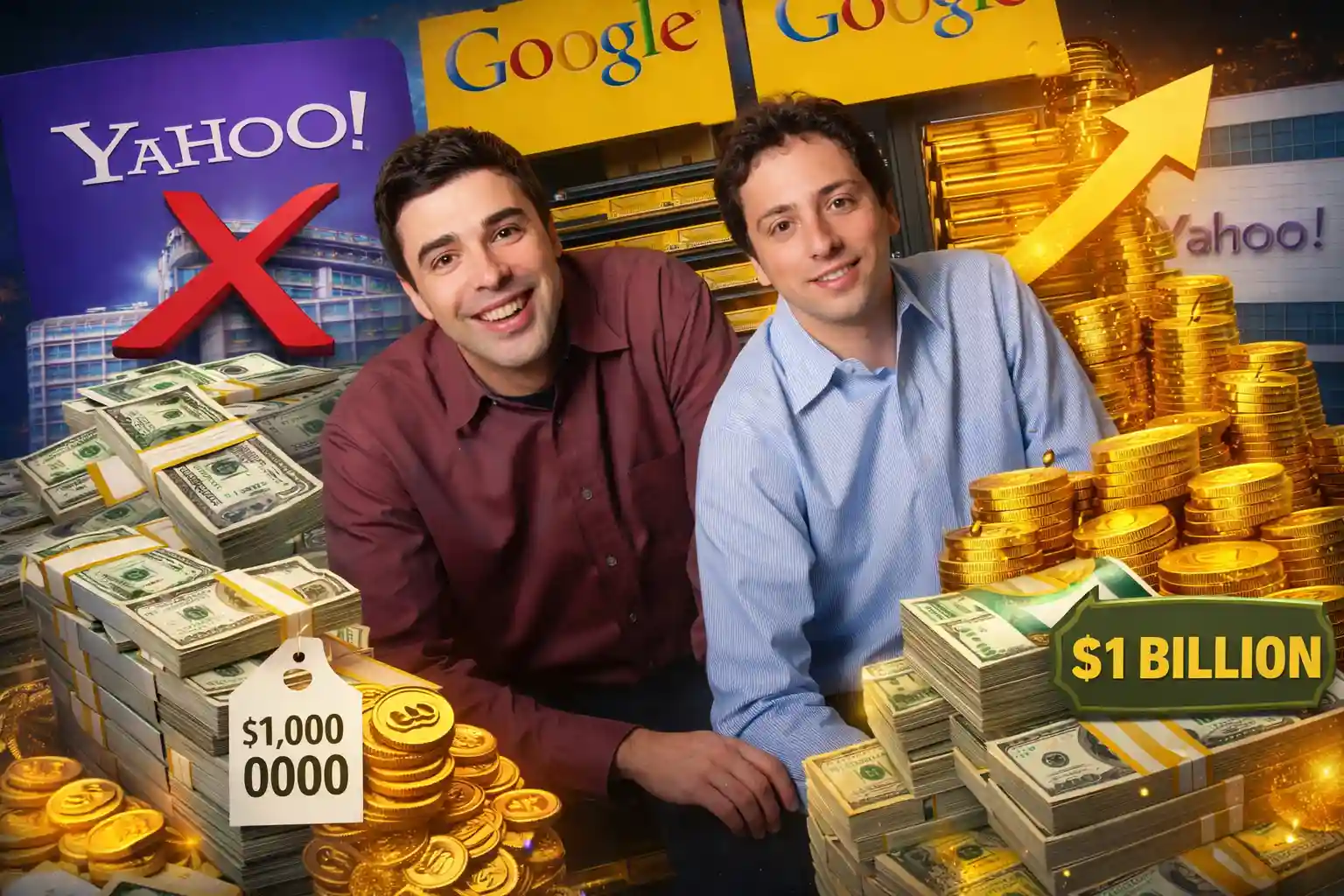
At the time, it didn’t look like a life-changing mistake. Two Stanford graduate students — Larry Page and Sergey Brin — had built a search engine they didn’t even want to run themselves. They were trying to sell it. Yahoo, already a giant of the early internet, had the chance to buy it for about $1 million.
They passed.
Four years later, they got another chance. This time, Google was no longer a student project — and the price had jumped to roughly $5 billion.
Yahoo tried to negotiate it down.
Google walked away.
The Scene: Two Students Trying to Walk Away
In the late 1990s, search engines weren’t the main event online. Yahoo wasn’t even really a search company — it was a directory. Humans categorized websites. You browsed the internet like a library, not a search bar.
Inside a Stanford dorm room, Larry Page and Sergey Brin were working on something different. Their system ranked pages based on links — a method that would later be called PageRank.
It worked better than anything else.
But they didn’t see themselves as CEOs. They were researchers. According to early accounts, they actively tried to sell Google because they wanted to go back to school and move on.
Yahoo was the obvious buyer.
And Yahoo didn’t see the urgency.
Who They Were — and Why This Moment Still Circulates
Yahoo was one of the biggest names on the internet in the late ’90s. Founded by Jerry Yang and David Filo, it was the homepage for millions of users. News, email, finance, sports — everything started there.
Google, on the other hand, was just a better search tool.
That difference mattered.
Yahoo made money by keeping users on its site. Google’s goal was the opposite — help users leave quickly by finding what they wanted.
That clash in philosophy is why this story still gets shared today. It’s not just about a missed deal. It’s about two totally different views of what the internet should be.
And one of them aged a lot better.
The Full Story: Two Chances, Two Misses
The first missed opportunity came around 1998.
Page and Brin reportedly approached Yahoo to sell Google for about $1 million. The exact details of the meeting vary depending on the source, but the outcome is consistent: Yahoo didn’t think search was that valuable.
At the time, that wasn’t crazy.
Search wasn’t seen as a major business. Banner ads and portal traffic were.
Google kept growing anyway.
By 2002, the situation had changed. Google was gaining traction fast. Its clean homepage stood out in a crowded, messy internet. Users trusted it.
Yahoo came back to the table.
This time, Google’s asking price was around $5 billion.
Yahoo hesitated again — and reportedly tried to lower the price to $3 billion.
That negotiation didn’t go well.
Google’s board, now more confident in its future, walked away from the deal entirely.
That was the end of it.
Google went on to dominate search, then advertising, then almost every corner of online life. In 2004, it went public. Over time, it grew into a company worth more than $2 trillion.
Yahoo never caught up.
In 2017, Yahoo sold its core business to Verizon for about $4.48 billion — less than what Google had asked for 15 years earlier.
One decision. Two chances. Same outcome.
Public Reaction: “The Most Expensive No Ever”
This story has lived on far beyond tech circles.
On Reddit, threads about “biggest business mistakes” often circle back to Yahoo and Google. Some posts pull thousands of comments, with users debating whether Yahoo really understood what it was turning down.
One recurring tone: disbelief.
A typical comment sums it up: “They had two chances and still missed it.”
On platforms like X (formerly Twitter), the story resurfaces every few months, often paired with updated numbers showing Google’s current valuation. The contrast keeps getting sharper.
Comedians have picked it up too.
Late-night hosts have joked about it as a kind of corporate cautionary tale — the business version of ignoring a lottery ticket that later turns out to be a winner.
Even business leaders reference it.
Mark Cuban has mentioned similar missed opportunities in interviews, pointing out how often companies underestimate early-stage ideas because they don’t fit the current model.
That’s the part people can’t stop talking about.
It wasn’t just a bad deal.
It was a failure to see where things were going.
The Bigger Truth Behind the Decision
Yahoo didn’t fail because it was careless.
It failed because it was successful — in a different way.
At the time, Yahoo’s model worked. Keeping users on the platform meant more ad revenue. A tool that sent users away quickly didn’t fit that goal.
Google flipped that logic.
The faster you found what you needed, the more you trusted the platform. That trust turned into search dominance. That dominance turned into ad revenue on a scale no one had seen before.
Yahoo wasn’t blind.
It just couldn’t pivot fast enough.
And when it finally tried, it was already too late.
The Moment That Still Stings
Picture that early meeting again — two students, a simple offer, a company that thought it had time.
Yahoo rejected Google.
At that moment, it looked like a small decision.
Today, it reads like one of the most expensive misjudgments in business history.
Because the real cost wasn’t just money.
It was missing the future when it was sitting right in front of you — and asking for $1 million.