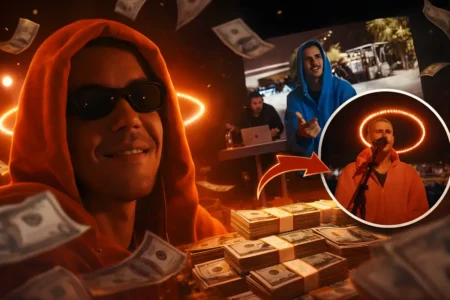



A folded piece of paper sat in a wallet for years, quietly carrying a future that didn’t exist yet. Jim Carrey didn’t have the money. Not even close.
But he had the number.
That number—Jim Carrey $10M check—is what turned a struggling comic into one of Hollywood’s most talked-about success stories.
The Scene
Late at night, long before the fame, Jim Carrey drove up to Mulholland Drive. The city lights of Los Angeles stretched out below him, glowing with everything he didn’t have yet.
He pulled out a check.
Carrey wrote it to himself: $10 million for “acting services rendered.”
He dated it Thanksgiving 1995.
Then he folded it and kept it in his wallet.
Who + Why Now
The story didn’t go viral right away. It gained real traction years later, after Carrey shared it publicly—most notably during interviews and in clips that continue to circulate online today.
People rediscover it in waves.
Usually when:
- motivation content trends
- manifestation stories go viral
- or someone asks, “Did this actually happen?”
The Jim Carrey $10M check has become one of the internet’s most repeated success stories—shared across YouTube, TikTok, Reddit, and self-help blogs.
But the details? That’s where things get messy.
The Full Story
In the mid-1980s, Jim Carrey was not the star people know now. He was doing stand-up, struggling to land roles, and at times barely getting by.
Some versions say he lived in a van with his family during tough periods. That part is partly true—his family did face serious financial hardship, and Carrey has spoken about those early struggles.
The check came during that phase.
He wasn’t famous. He wasn’t rich. He was trying to break in.
So he created a target.
He carried that check for years. Not days. Years.
Every time he opened his wallet, he saw it.
Every time he doubted himself, it was there.
A reminder.
A promise.
Then things started to change.
In the early 1990s, Carrey’s career took off. “In Living Color” gave him visibility. Then came a run that few actors ever match:
- Ace Ventura: Pet Detective (1994)
- The Mask (1994)
- Dumb and Dumber (1994)
Suddenly, he wasn’t just working—he was one of the most in-demand comedic actors in Hollywood.
And here’s where the story hits its turning point.
He eventually earned $10 million for a film role, often linked in retellings to Dumb and Dumber (though reported figures vary depending on the source and deal structure).
The exact match between the check and the paycheck is where fact and storytelling start to blend.
But the timing?
Close enough to make people stop and think.
Very close.
There’s one more detail that keeps this story alive.
After his father died, Carrey placed that same worn check—now old and faded—into his father’s coffin.
His father had believed in him before the fame.
Before the money.
Before the proof.
Public Reaction
On platforms like Reddit and YouTube, the Jim Carrey $10M check story splits people into two camps.
Some see it as proof of manifestation.
Others see it as selective storytelling.
A Reddit thread with hundreds of comments summed up the divide: half the replies praised the mindset—“visualize it until it’s real”—while others pushed back, pointing out that talent, timing, and industry access matter just as much.
On TikTok, clips of Carrey telling the story rack up millions of views, often paired with captions about “law of attraction” or “speak it into existence.”
Meanwhile, fact-check discussions pop up regularly, especially around:
- how much he was actually paid for specific films
- whether the timeline lines up perfectly
- and how much of the story has been simplified over time
Comedians have also referenced it in a more grounded way—less magic, more mindset.
The joke isn’t that writing a check makes you rich.
It’s that believing you’re worth it might change how you act next.
Bigger Truth
The power of this story isn’t in whether every detail is exact.
It’s in how simple it is.
A broke actor wrote down a number he believed he could reach—and carried it until his life caught up.
No system. No secret formula.
Just a target and the refusal to drop it.
That’s what people hold onto.
Not the check itself.
But what it represents.
Conclusion
Back on that hill, with nothing but city lights and a blank check, Jim Carrey made a decision most people never make.
He chose a number before the world gave him one.
Years later, the money came.
The fame followed.
But that small piece of paper stayed with him the whole time—quiet, folded, and waiting.
And the question it leaves behind isn’t about Hollywood.
It’s this:
What would you write on your own check if you believed it might come true?