


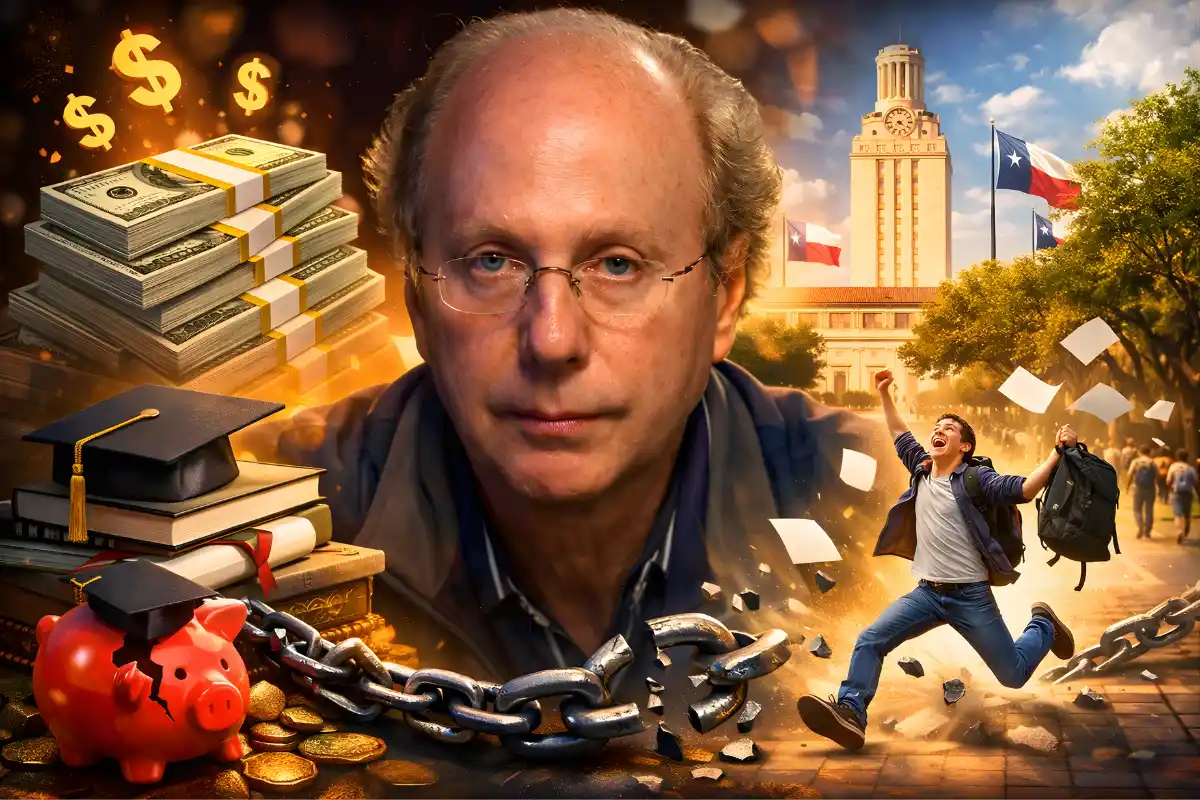
College in the United States often leaves students with decades of debt. The country’s student loan balance sits above $1.7 trillion, and many graduates spend years paying it off. Now one new university in Texas is trying something very different: no tuition at all.
That idea moved closer to reality after billionaire investor Jeff Yass donated $100 million to the University of Austin, a young private school that says it plans to keep tuition permanently free for students.
A $100 Million Push for Free College
The headline sounds almost unreal.
A billionaire gives money.
A university removes tuition.
But that is exactly what happened.
Here are the key facts:
- Investor Jeff Yass donated $100 million to the University of Austin.
- The funding helps support the University of Austin free tuition model, which aims to eliminate tuition for students permanently.
- The donation launches a $300 million fundraising effort to keep the university running through private support instead of tuition payments.
- The school opened in 2021 and welcomed its first students in 2024.
- The campus currently has about 150 students, with plans to grow to roughly 500 students.
Students will still pay for housing, meals, and books.
But the largest cost of college — tuition — is meant to disappear.
That alone makes people stop scrolling.
The Man Behind the Donation
Jeff Yass is not a typical donor.
He is a billionaire trader and the co-founder of Susquehanna International Group, a major financial firm.
His views on education are clear.
He supports new models that rely less on government funding and more on private backing.
The University of Austin fits that idea perfectly.
The school says it plans to operate under two big rules:
- No tuition for students
- No government funding
Instead, it hopes donations and endowments will keep the school running long-term.
That approach is rare in modern higher education.
Why the University of Austin Exists
The University of Austin is not just another campus.
It was started by academics and writers who believed traditional universities were losing their focus on open debate.
Some of the figures behind the project include:
- Journalist Bari Weiss
- Historian Niall Ferguson
- Venture investor Joe Lonsdale
Their goal was to build a school where debate is encouraged and students study classic subjects like history, philosophy, and economics.
Because of that mission, the university quickly became a talking point online.
Supporters call it a fresh start for higher education.
Critics sometimes label it a political project.
Either way, the attention has been constant.
The Internet Had Opinions
When news of the University of Austin free tuition plan spread online, reactions were quick and loud.
Some people praised the move.
Common comments included:
“This is what college should look like.”
Others saw the irony.
“Free college… funded by a billionaire.”
Memes appeared within hours.
One popular meme format showed a student staring at a tuition bill next to a caption reading:
“Wait… we could have just done this?”
Another viral joke summed up the moment perfectly:
“Apparently the path to free college is finding the right billionaire.”
Even comedians joined the fun online.
The typical punchline went something like this:
“College costs $80,000 a year. Unless a rich guy wakes up and decides it shouldn’t.”
Why This Story Strikes a Nerve
The reason this story spreads so easily is simple.
College costs a lot.
Many students graduate with debt that lasts for years.
People often debate how to fix the system.
Common proposals include:
- government-funded tuition
- student loan forgiveness
- lower university costs
The University of Austin free tuition approach offers another idea.
Private donors cover the cost.
Students attend without paying tuition.
If the model works, it could show a different way to run a university.
Questions Still Remain
Of course, the plan also raises a few questions.
Critics often point to three main concerns.
1. Long-term funding
Donations must keep coming for the model to survive.
Universities usually rely on steady tuition income.
2. Academic reputation
The university is still working toward full accreditation.
That process takes time.
3. Donor influence
Some observers wonder whether large donors could shape the direction of the school.
Supporters say strong governance rules can prevent that.
Still, the debate continues.
A University That Feels Like a Startup
One unusual thing about the University of Austin is how new it is.
Most universities grow slowly over decades.
This one appeared almost overnight.
Timeline highlights:
- Founded in 2021
- First students arrived in 2024
- Enrollment still under 200 students
That makes it feel more like a startup than a traditional university.
Some people love that idea.
Others remain cautious.
Starting a university from scratch is not easy.
Could Other Colleges Copy the Model?
That may be the biggest question raised by the story.
What if more universities removed tuition?
A few small schools already offer tuition-free education funded by donations.
Examples include special scholarship institutions and music academies.
But building an entire university around the idea is rare.
If the University of Austin free tuition model succeeds, it could inspire others to try similar systems.
If it fails, critics will point to it as proof the idea cannot scale.
Either way, it will be watched closely.
CONCLUSION
A billionaire writes a $100 million check.
A new university promises free tuition.
Students sign up.
The rest of the country watches.
Maybe it becomes a small experiment.
Maybe it changes how people think about college costs.
For now, one thing is certain.
The moment someone says “free tuition,” the internet stops arguing for a second… and starts asking how to apply.