


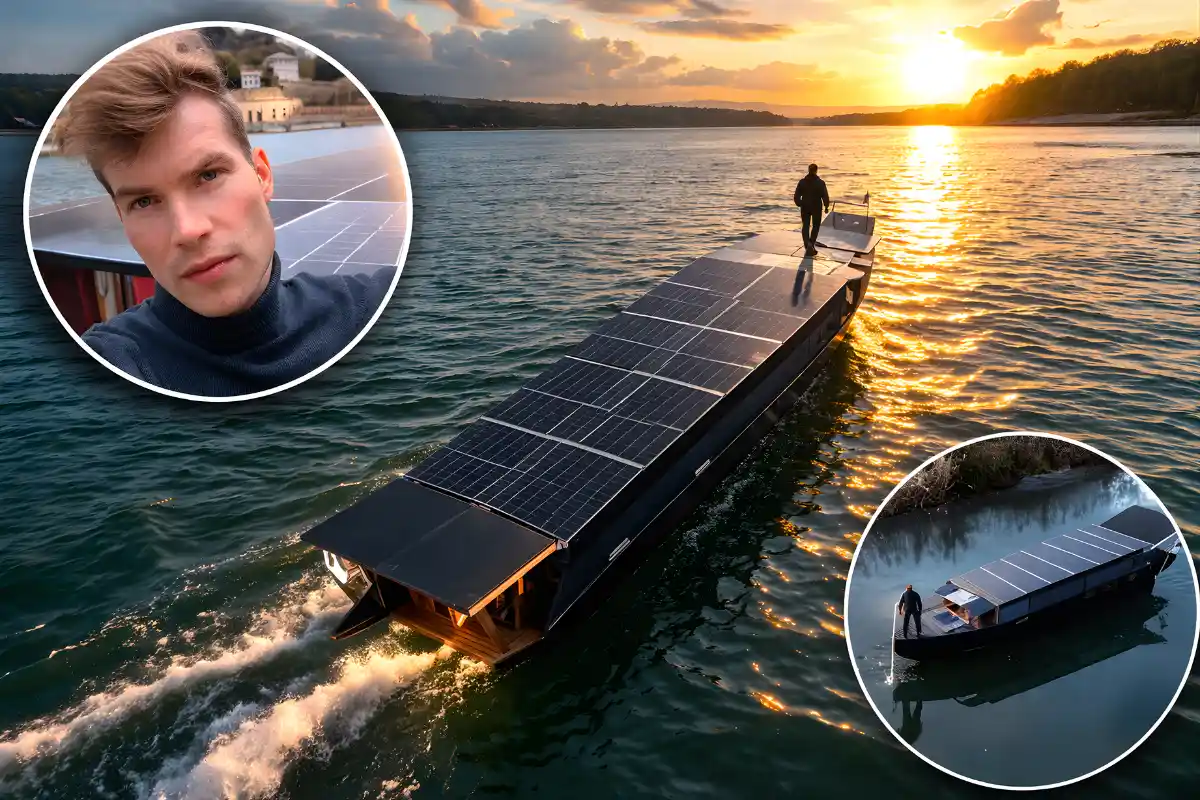
The quiet is what gets you first.
No engine rumble, no fuel smell, just the soft push of water as a solar powered yacht glides forward like it doesn’t belong to the same era as everything around it. That moment—one person standing on a long, panel-covered boat moving at 6.5 knots without fuel—is what turned this build into a viral talking point.
At the center of it is a solo builder who spent roughly 200 days designing and assembling a solar-powered vessel from the ground up. The promise sounds simple: a boat that can run continuously using sunlight alone. The real question people immediately ask is even simpler—can it actually work outside of perfect conditions?
The One Detail Most People Miss
Most people assume boats need constant fuel to move. That’s been true for decades. Diesel engines dominate everything from small yachts to cargo ships, and fuel costs can run into thousands per trip.
This is where a solar powered yacht flips expectations.
Instead of burning fuel, the boat’s entire upper surface is covered in photovoltaic panels. These panels convert sunlight into electricity, which feeds directly into electric motors and onboard batteries. When conditions are right, the system can generate enough power to keep the boat moving indefinitely.
That’s the theory.
What makes this specific build stand out is the balance between energy production and consumption. At around 6.5 knots, the power needed to move the boat matches what the panels can produce during daylight hours.
It’s not fast.
But it’s steady.
What a Solar Powered Yacht Actually Is
In plain terms, this type of boat is closer to an electric car than a traditional yacht. Instead of a fuel tank, it relies on three core systems working together:
Solar panels collect energy from sunlight
Batteries store excess energy for later use
Electric motors convert stored energy into motion
The long, narrow shape of the hull is not just for style. It reduces drag in the water, meaning the boat needs less energy to move. That design choice is what makes lower speeds like 5 to 7 knots realistic without draining the system.
It’s a trade-off.
Speed for independence.
What This Means in Real Life
For anyone who has looked at fuel prices lately, the appeal is obvious.
Marine fuel costs have climbed alongside global energy prices, and even small recreational boats can burn through hundreds of dollars in a single outing. A solar powered yacht offers something rare in boating—predictable operating costs.
Once built, sunlight is free.
That doesn’t mean the system is cheap. Solar panels, lithium batteries, and electric motors come with a high upfront cost. Commercial solar yachts from companies like Silent Yachts can run into the millions.
But the long-term math changes for people who use their boats often.
No fuel stops.
No engine noise.
Lower maintenance.
The Limits People Are Pointing Out
That’s where the online conversation splits.
On platforms like Reddit and YouTube, where DIY builds often gain traction, the reaction has been mixed. Some users focus on the freedom from fuel, while others point out the obvious limits.
Cloud cover matters.
Night travel depends on stored battery power.
Speed remains low compared to traditional yachts.
A boating forum thread discussing similar solar builds drew hundreds of replies, with one common theme: “Great for slow travel, not for getting somewhere fast.”
That’s the reality.
Solar boats don’t compete with speedboats.
They compete with time.
Why This Is Happening Now
This shift toward solar powered yacht designs didn’t come out of nowhere.
It sits at the intersection of three larger trends:
Rising fuel costs pushing people to look for alternatives
Advances in battery technology making storage more reliable
A growing interest in off-grid living and self-sufficiency
According to data from the International Energy Agency, solar power costs have dropped sharply over the past decade, making projects like this more accessible than they once were.
At the same time, electric propulsion has improved enough to handle steady marine use without the reliability concerns that held it back in the past.
Put those together, and a solo builder attempting a fully solar vessel starts to make sense.
The Debate Around “Run Forever”
The phrase “run forever” is where things get complicated.
Technically, a solar powered yacht can keep moving as long as it produces as much energy as it uses. In ideal sunlight, at a steady low speed, that balance is possible.
But it’s fragile.
Change the weather.
Add passengers.
Increase speed.
The system tips.
Experts in marine design often point out that most real-world applications will rely on hybrid systems—solar paired with backup generators or shore charging. Fully solar operation works best in controlled conditions, not rough or unpredictable seas.
Still, the idea sticks with people.
Because it feels like a break from the usual limits.
A Human Story Behind the Build
The most compelling part isn’t the tech. It’s the time.
Two hundred days of building means daily problem-solving, trial and error, and a level of patience most people don’t have. DIY boat projects often stall out long before completion, especially when they involve electrical systems and water.
This one didn’t.
That’s why it spread.
It’s not just about a solar powered yacht. It’s about one person proving that a complex idea can actually be built outside of a company or factory.
And people notice that.
The Quiet Shift in Boating
There’s a subtle change happening in how people think about boats.
For decades, bigger engines meant better boats. More speed, more power, more fuel.
Now there’s a different kind of appeal.
Silence.
Efficiency.
Independence.
Solar powered yachts don’t replace traditional boats yet. But they introduce a new option—one that trades speed for control over energy.
That trade is starting to make sense to more people.
Back to That Moment on the Water
It comes back to that image: one person standing on a long strip of solar panels, moving steadily across open water with no fuel in sight.
No rush.
No noise.
Just motion powered by sunlight.
The next real milestone isn’t speed. It’s scale—when solar powered yacht designs move from one-off builds to something more common on marinas.
Until then, the question isn’t whether it works.
It’s how many people are willing to slow down enough to use it.