

OPENING HOOK
It’s the kind of image that makes everything else feel small.
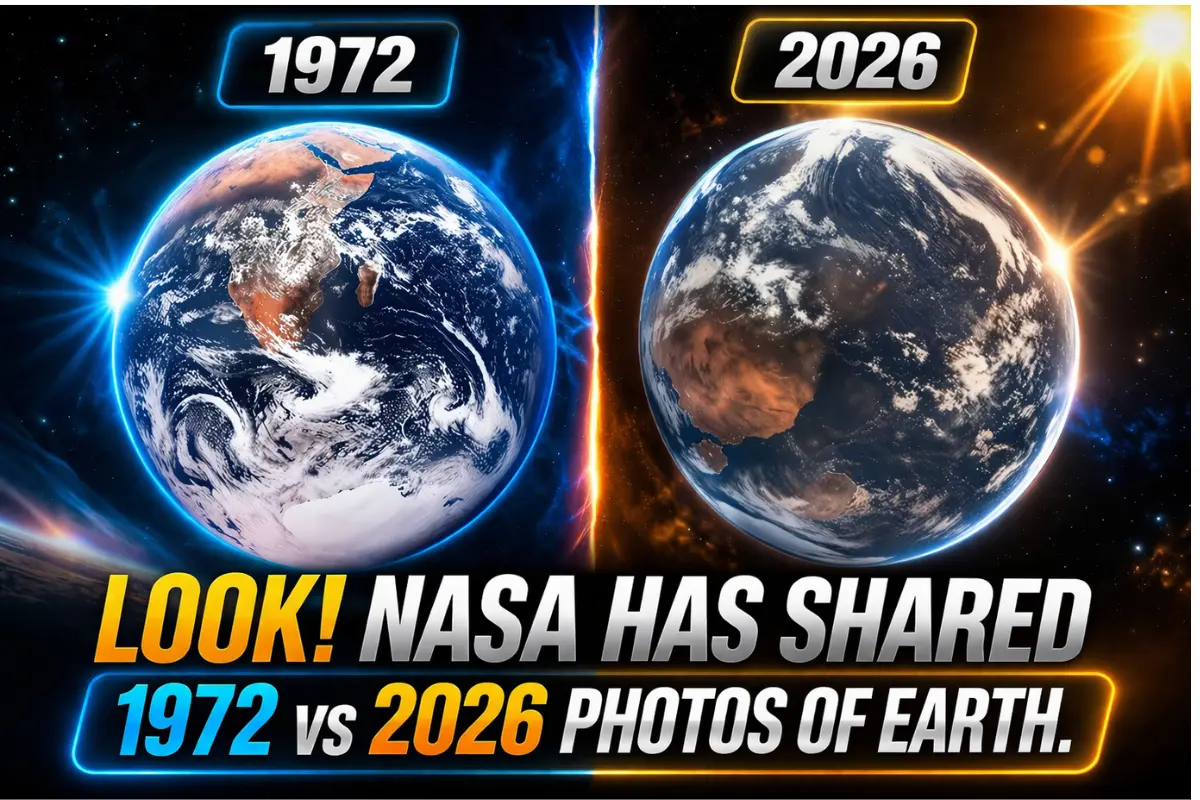
The phrase Blue Marble Earth doesn’t sound like much—until you realize you’re looking at the same planet, frozen in time, 54 years apart.
In 1972, astronauts from NASA took a photo that would define how humans see their home. In 2026, a new crew returned with another. At first glance, nothing seems different.
That’s the point.
And that’s what’s unsettling.
A Surprising Fact Most People Miss
Most people assume Earth would look drastically different after five decades of climate talk, rising temperatures, and global change.
It doesn’t.
From space, the Blue Marble Earth still shows the same deep blue oceans, the same swirling white clouds, the same calm, almost perfect sphere.
But that visual sameness hides a deeper truth: the biggest changes aren’t always visible from far away.
Scientists point out that while the surface appearance feels familiar, key systems—ice levels, heat patterns, and atmospheric conditions—have shifted in measurable ways.
You’re seeing the same picture.
You’re not seeing the same reality.
What Is the Blue Marble Earth, Really?
The original Blue Marble Earth image came from the Apollo 17 crew.
They were about 29,000 kilometers from Earth when they captured it—fully lit by the Sun, with no shadow cutting across the planet. That alone made it rare. Most space images show partial darkness.
It quickly became one of the most reproduced images ever taken.
Not because it was technically impressive.
Because it was emotional.
For the first time, people saw Earth not as countries or borders, but as one shared place. A single, fragile sphere floating in black space.
Fast forward to today, and Artemis II is bringing humans back into deep space. The new images use advanced digital sensors, sharper detail, and better color accuracy.
Same subject.
Different tools.
And a very different context.
How This Actually Affects Daily Life
You might wonder what a space photo has to do with everyday life.
More than you’d expect.
The modern Blue Marble Earth images are used in:
- Climate monitoring systems that track heat and cloud shifts
- Weather forecasting models that affect farming and travel
- Environmental policy reports tied to energy and cost of living
- Satellite imaging tech that supports GPS, logistics, and insurance
That means the same type of imagery that once inspired posters now feeds into decisions that shape fuel prices, food supply, and even disaster planning.
It’s not just a picture anymore.
It’s data.
And that data connects directly to how people work, travel, and spend money.
What’s Changed—and Why Some Experts Are Concerned
Despite the calm look of the Blue Marble Earth, scientists have flagged several real changes.
Polar ice coverage has decreased, especially in the Arctic.
Atmospheric haze has increased in certain regions due to pollution and heat.
Cloud formations are shifting in ways that affect rainfall patterns.
According to climate data referenced by agencies like NASA and global research groups, average global temperatures have risen by over 1°C since the late 20th century.
That may sound small.
It isn’t.
That shift affects storms, crops, and water supply across entire regions.
Still, not everyone agrees on how urgent or visible the changes are.
Some experts argue that Earth’s systems naturally fluctuate over time and that long-term trends need more context. Others say the pace of change today is faster than natural cycles would explain.
The debate isn’t about whether change exists.
It’s about how fast—and how serious—it is.
The Human Side of the Image
For many people, the Blue Marble Earth isn’t about science.
It’s about perspective.
A widely shared Reddit thread with thousands of replies summed it up simply: “Same Earth, different problems.”
That line stuck.
Because it feels true.
The image hasn’t changed much.
But life on it has.
Costs are higher. Weather feels less predictable. News cycles move faster. And yet, from space, none of that shows.
Just a quiet blue sphere.
Even Neil deGrasse Tyson has pointed out that the original Blue Marble may be the most powerful environmental image ever taken—not because it warned people, but because it made them feel something.
That feeling hasn’t gone away.
If anything, it’s sharper now.
The Real Obstacle: Seeing What’s Not Visible
The biggest challenge with the Blue Marble Earth comparison is simple.
The most important changes don’t show up clearly in the image.
You can’t see rising temperatures.
You can’t see carbon levels.
You can’t see long-term stress on ecosystems.
That creates a gap between what people feel and what they see.
If it looks the same, it must be fine.
Right?
Not necessarily.
That’s why scientists rely on data, not just visuals. Satellites measure heat, gases, and movement in ways the human eye never could.
The photo tells a story.
The data tells the rest.
CONCLUSION
Back in 1972, the astronauts who captured the first Blue Marble Earth didn’t know their photo would define how generations see the planet.
They just turned the camera and took the shot.
Today, astronauts are doing the same thing—pointing a lens back home.
The image still looks calm. Still looks whole. Still looks untouched.
And maybe that’s why it matters more now than ever.
Because if everything looks fine from that far away… what are we missing up close?