


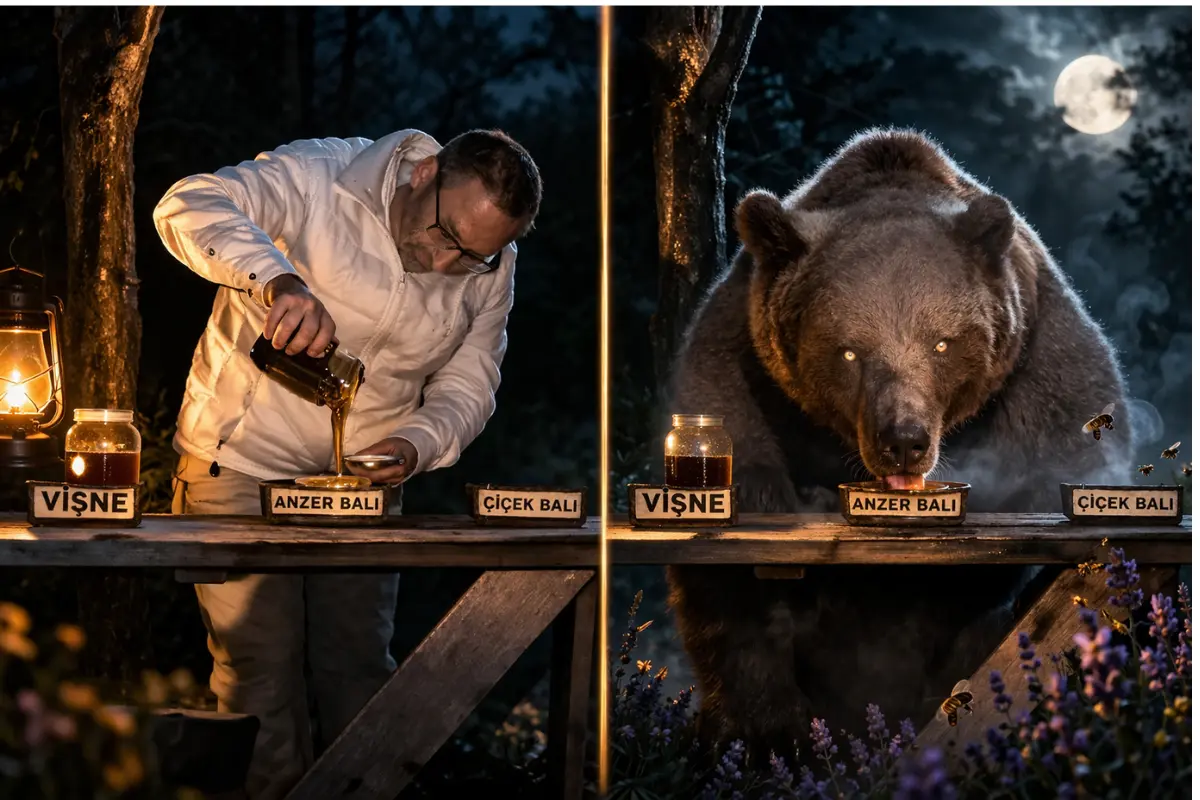
The kind of loss that keeps you up at night doesn’t always come from people. Sometimes, it walks on four legs and leaves sticky paw prints behind.
In the hills of Trabzon, beekeeper Ibrahim Sedef wasn’t dealing with random damage. His hives were being targeted, repeatedly, by brown bears. Over time, the losses crossed $10,000. What started as frustration turned into something else entirely when he decided to stop chasing the bears away—and instead, watch what they actually wanted.
The Moment That Changed Everything
One night, instead of reinforcing his hives again, Sedef set out bowls.
Not traps. Not deterrents.
Options.
Different types of honey were placed side by side—flower honey, chestnut honey, and the rare, expensive Anzer honey. He added cherry jam too, expecting the sugar-rich spread might distract them.
Then he walked away and let the cameras roll.
The Full Story Unfolds
At first, the footage looked like what you’d expect. A bear approaches slowly, sniffing the air, cautious but confident. It pauses near the bowls, moving its head from one to the next.
Then something unexpected happens.
The bear doesn’t just eat.
It chooses.
It samples briefly, then returns to one bowl again and again—the Anzer honey. The same pattern repeats across multiple visits. Different bears, same preference. The cheaper honey stays mostly untouched in comparison. Even the cherry jam, which should have been an easy win, gets ignored after a quick taste.
The pattern becomes impossible to miss.
These bears are not eating randomly. They are selecting the highest-quality option.
And they are doing it consistently.
The Detail That Makes It Real
Anzer honey isn’t just another local product. It comes from the Anzer Plateau in northeastern Turkey, an area known for its dense mix of alpine flowers—more than 90 species in a small region.
That diversity gives the honey a strong aroma and a rich, layered taste. It also makes it rare. Supply is limited. Prices can reach around $300 per kilogram.
Sedef didn’t need lab results to confirm what the footage showed.
The most expensive honey on the table was the first to disappear every time.
From Loss to Observation
At some point, the frustration fades.
That’s what stands out in Sedef’s reaction. After years of damage, he doesn’t describe the bears as pests anymore. Watching them choose, return, and repeat the same behavior changed how he saw them.
He didn’t just lose product.
He witnessed a pattern.
And that pattern felt strangely familiar.
People, given options, often do the same thing—reach for what smells better, tastes richer, feels worth it.
Even when it costs more.
Why This Story Spread So Fast
There’s something about this moment that hits instantly.
Part of it is the humor. Online, people framed the bears as “luxury consumers” or “food critics.” Posts comparing them to high-end shoppers picked up quickly, especially on platforms like Reddit and X, where threads leaned into the idea that even animals “know the difference.”
One recurring joke kept showing up: if bears can tell quality, maybe humans aren’t as complicated as they think.
Another angle made it more relatable.
People tied it to everyday decisions—buying better food, paying extra for quality, or skipping cheaper options that don’t deliver. The bears weren’t just animals anymore. They became a reflection.
Simple choices. Clear preferences.
No overthinking.
A Pattern That Feels Human
The strange part isn’t that bears like honey.
It’s that they seem to rank it.
Brown bears are known for their strong sense of smell and their need for high-calorie foods. That explains why they go after honey in the first place. But this goes a step further. The repeated selection suggests they’re not just chasing sugar—they’re responding to something more specific, likely aroma or nutrient density.
And they stick with it.
Every time.
That consistency is what turns a local problem into a story people keep sharing.
Because it doesn’t feel random.
It feels intentional.
One Simple Scene, One Last Beat
Back in Trabzon, the setup is still simple. Bowls. Cameras. Quiet nights.
The bears come and go.
They don’t rush. They don’t fight over everything.
They choose.
And each time they return to that same bowl, the one that costs the most, it leaves behind the same quiet thought:
Maybe taste isn’t as complicated as people make it.