

There’s a moment in the middle of the workday when everything goes quiet, but not in a good way.
For many dealing with Gen Z workplace burnout, that moment isn’t a break—it’s a shutdown.
The Employee Who Started Skipping Lunch for Silence
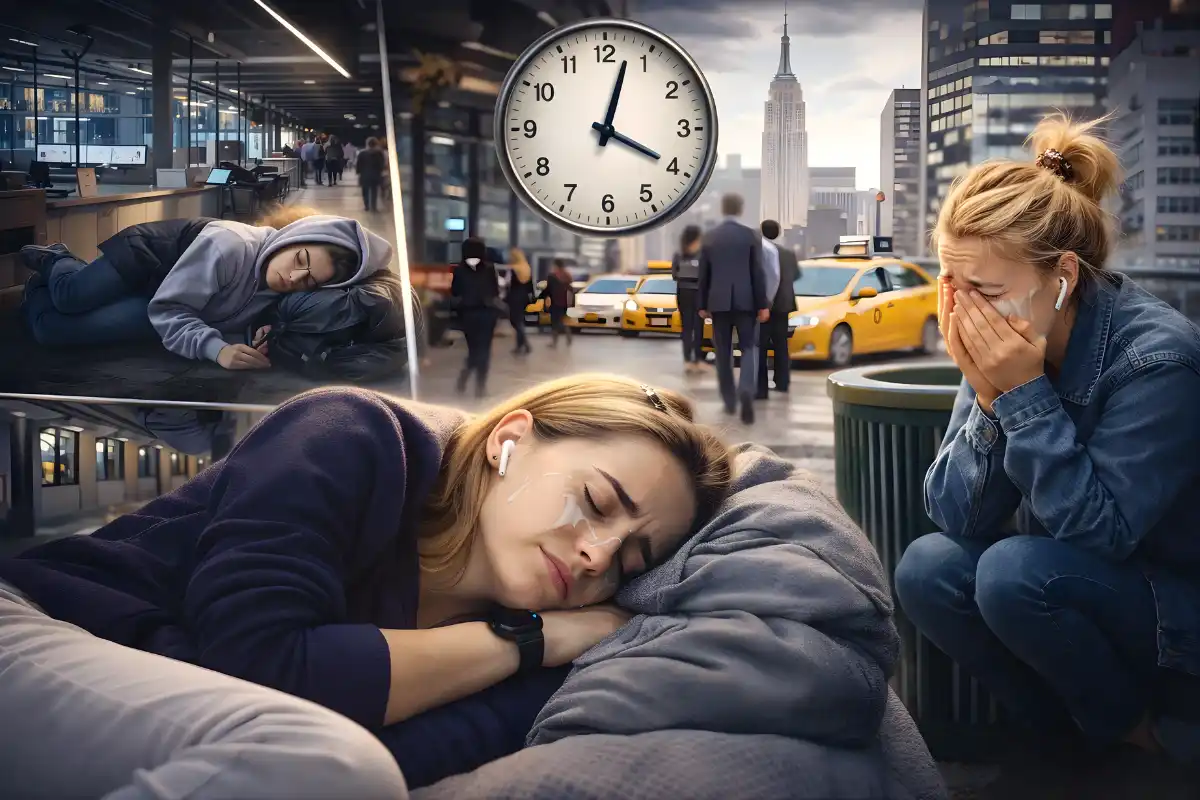
At 26, a marketing assistant in Manhattan stopped using her lunch break for food. Instead, she walks into a nearby nap pod space, pays $27, and lies down in silence for 30 minutes.
No scrolling. No calls. No talking.
Just recovery.
She says it’s the only way she can make it through the rest of the day.
The Numbers Behind Gen Z Workplace Burnout
This shift isn’t isolated. It’s becoming a pattern across major cities like New York.
Some workers now spend their breaks:
- Paying $15 to sit in dark movie theaters just to rest
- Renting nap pods for short sleep cycles
- Sitting alone in parks, bathrooms, or subway stations to decompress
At the same time, workplace data shows a contradiction.
98% of employees say breaks improve performance.
Only 38% actually take them.
And nearly half of Gen Z workers admit they skip lunch multiple times a week—often out of guilt.
So when they finally stop, it’s not for a sandwich.
It’s because they have to.
Why This Is Happening Now
Work hasn’t necessarily gotten longer. But it has gotten heavier.
Constant notifications. Back-to-back meetings. Slack messages that never stop.
The modern workday isn’t just about tasks—it’s about attention.
And attention runs out.
A study from the American Psychological Association links rising workplace fatigue to continuous digital interruption and mental overload. The brain never fully resets.
That’s where the midday collapse comes in.
Short naps—just 10 to 20 minutes—have been shown to improve focus and reduce stress. For Gen Z workers, this isn’t indulgence.
It’s damage control.
There’s also a cultural shift at play.
Older generations were taught to push through exhaustion. Gen Z is more likely to stop when their body signals a limit.
They don’t see rest as weakness.
They see it as maintenance.
The Debate Around It
Not everyone agrees this is a healthy trend.
Some managers argue it shows a lack of resilience. The idea that employees need to cry or nap during work hours raises concerns about productivity and reliability.
Others see it differently.
Mental health professionals point out that these behaviors are signs of awareness, not failure. Instead of suppressing stress until burnout hits, workers are releasing it in real time.
On platforms like TikTok, millions of views have gathered around “midday reset” videos—people documenting their quiet breaks, their emotional pauses, even their worst days.
On Reddit, long threads echo a similar idea: this isn’t new behavior.
It’s just visible now.
Workers have always stepped away to cry in bathrooms or sit in their cars. The difference is that Gen Z is no longer hiding it.
They’re naming it.
The Real Cost of Pushing Through
For someone earning an average salary in a major city, spending $20–$30 just to rest in the middle of the day sounds extreme.
But burnout has its own price.
Lost focus. Mistakes. Quitting jobs without a plan.
A single bad week can cost more than a month of “reset breaks.”
So workers are making a trade.
Pay now for a controlled pause, or pay later with a full breakdown.
And in cities like New York, where going home isn’t an option during lunch, people improvise.
A quiet corner becomes therapy.
A dark theater becomes a recovery room.
A beanbag in an office becomes the only place someone can breathe.
The Feeling Most People Recognize
You’ve probably felt it.
That moment when you stare at your screen, reread the same sentence five times, and still don’t process it.
Your body is there, but your mind has checked out.
For many Gen Z workers, that moment doesn’t pass.
It builds.
Until something gives.
Back to the Beanbag
Back in that open office, the employee on the beanbag hasn’t moved for 20 minutes.
No one interrupts her.
No one asks why.
Because quietly, more people understand than they admit.
She’s not being lazy.
She’s resetting.
And if the workday demands that much just to get through it—
what does that say about the system everyone else is still trying to push through?