


Free college tuition sounds like something people argue about online, not something that actually shows up in real life.
Then a $100 million check changed that.
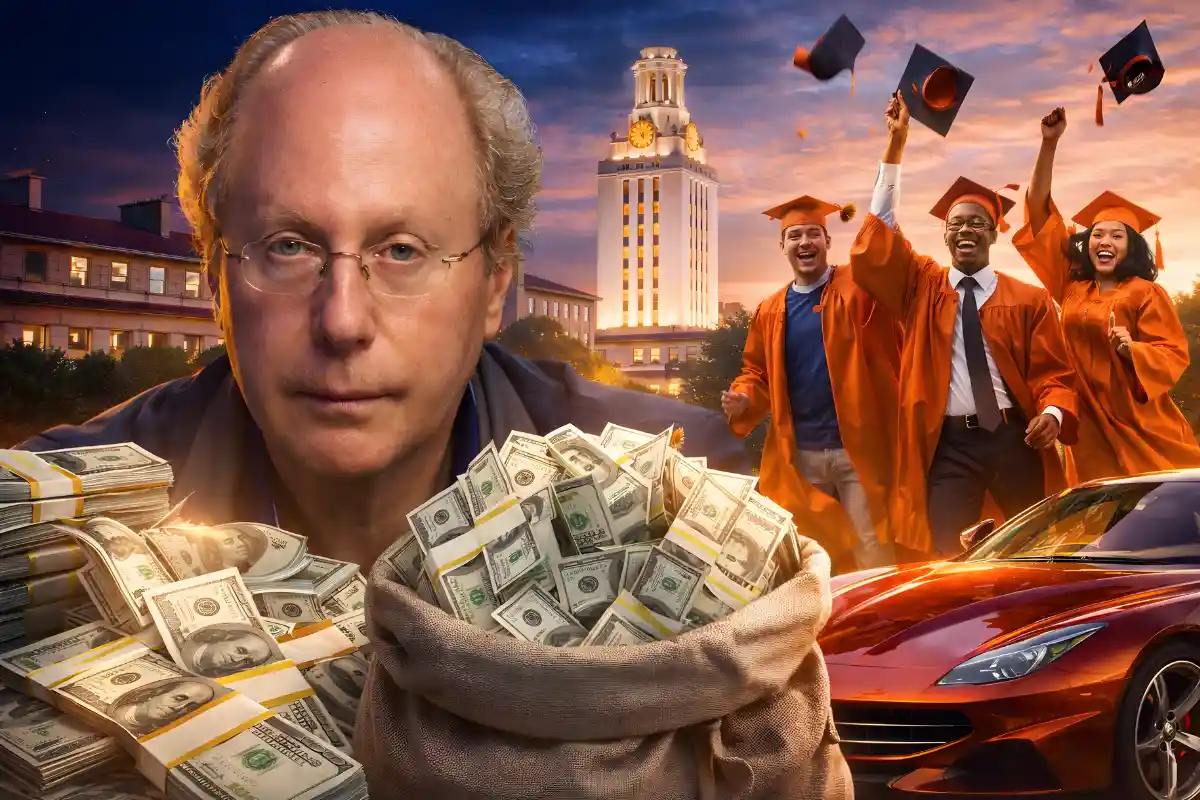
When news broke that billionaire investor Jeff Yass had donated $100 million to the University of Austin to fund free college tuition, the first question wasn’t “why”—it was “is this real, and who actually gets it?”
The Student at the Center
For students like Daniel, a 19-year-old first-year applicant from Texas, the idea of free college tuition feels almost unreal.
He grew up hearing the same advice most people do: pick a major carefully, avoid debt if you can, and expect to spend years paying it off anyway.
“I just assumed loans were part of life,” he said in a local interview.
Now, schools like the University of Austin are offering something different—no tuition at all.
That changes the math overnight.
The Core Fact and What It Means
Jeff Yass’s $100 million donation is designed to make tuition free for every student at the University of Austin.
Not discounted. Not reduced.
Free.
But there’s a catch most headlines don’t mention: students still pay for housing, food, and daily living expenses.
Even so, removing tuition—often the largest cost—can mean the difference between graduating debt-free or carrying tens of thousands of dollars into adult life.
In the U.S., student loan debt has reached about $1.7 trillion, affecting more than 40 million people.
That’s not abstract.
That’s rent delayed, homes not bought, and careers shaped around repayment plans.
So when one school says “no tuition,” people pay attention.
Why This Is Happening
The University of Austin is not a typical college.
Founded in 2021, it was built as an alternative to traditional universities, with a focus on free speech and independent funding.
Unlike most schools, it does not rely on government money.
Instead, it depends on donors.
Jeff Yass, a co-founder of trading firm Susquehanna International Group, is one of its biggest backers. He has also supported education initiatives in the past, including school choice programs.
His approach to free college tuition is based on a simple idea: if students succeed, they give back later.
If they don’t, the model fails.
That flips the usual system.
Most universities get paid upfront—through tuition or government aid—regardless of long-term outcomes.
This model ties survival to results.
But it only works at a small scale for now.
The University of Austin currently has fewer than 200 students, with plans to grow to around 400–500.
That’s tiny compared to major universities with tens of thousands of students.
And while $100 million sounds massive, many large universities operate with endowments in the billions.
The Debate Around Free College Tuition
The reaction online has been split, and not quietly.
On Reddit, a thread about the donation drew hundreds of replies within hours.
Some users called it “a glimpse of what college should be.”
Others were skeptical.
One common concern: influence.
If a school depends on donors instead of public funding, who shapes what is taught?
Supporters argue that private funding allows more independence from political pressure.
Critics argue it simply shifts that influence elsewhere.
There’s also the question of scale.
A single university offering free college tuition is not the same as a nationwide system.
It helps hundreds, not millions.
Still, for those hundreds, the impact is immediate.
And that’s where the conversation gets personal.
Because for many people, college isn’t just about education—it’s about risk.
The Moment That Feels Familiar
If you’ve ever looked at tuition numbers and tried to make them make sense, you know the feeling.
You do the math.
Then you do it again.
And it still doesn’t add up.
So you tell yourself it’s normal.
That everyone has debt.
That it’s just part of the deal.
Now imagine removing the biggest number from that equation entirely.
No tuition.
Just gone.
That’s why stories like this spread so quickly.
Not because they solve everything, but because they show something different is possible—even if only in one place, for now.
The Bigger Picture Behind One Donation
Free college tuition exists in other parts of the world, but usually through government funding.
Countries like Germany and Norway offer low-cost or tuition-free education funded by taxes.
The University of Austin is trying something else.
Private money replacing public systems.
That brings both flexibility and uncertainty.
If donations continue, the model grows.
If they don’t, it shrinks.
That’s the trade-off.
And it’s why this story is being watched closely—not just by students, but by policymakers and educators.
Because if it works, it raises a bigger question:
Why is this so rare?
Closing Moment
Back in Texas, Daniel is still deciding where to apply.
He’s comparing schools, costs, and what each option means for his future.
But now there’s a new factor in the decision.
Not a discount.
Not a scholarship.
Free college tuition.
And once you’ve seen that as a real option, even once, it’s hard not to ask:
Why isn’t it everywhere?