
That split second when you realize something isn’t right—but it’s already too late.
The Tesla Cybertruck lawsuit centers on that exact moment. A woman, Justine Saint Amour, says her vehicle, set to Full Self-Driving mode, suddenly veered on a highway overpass and slammed into a concrete barrier—while her infant sat in the car. She is now seeking about $1 million in damages, and the case is quickly becoming a focal point in the debate over how safe “self-driving” technology really is.
The Moment That Started It
For Justine Saint Amour, it wasn’t a slow build. It was immediate.
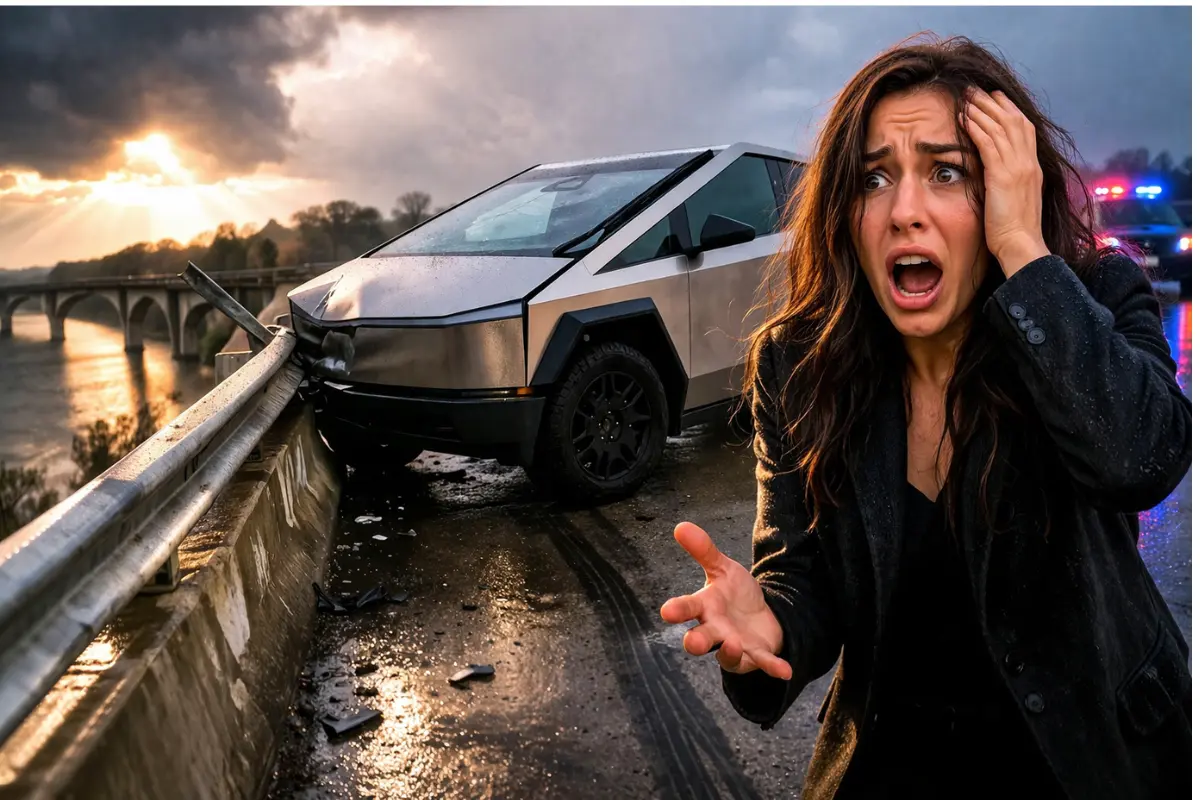
She says the Cybertruck drifted off its lane on an elevated roadway and headed toward danger before she could react. There was no warning she could process in time. No clear chance to take control.
One second, everything was normal.
The next, the vehicle had already lost its path.
Her lawsuit claims the system failed to maintain safe control, putting both her and her infant at risk. The image of a car nearly going off a bridge has become the emotional center of the case, giving it traction far beyond a typical crash claim.
What “Full Self-Driving” Actually Means
Many drivers assume the term speaks for itself. It doesn’t.
Tesla markets its system as “Full Self-Driving,” but regulators classify it as Level 2 driver assistance. That means the car can steer, accelerate, and brake under certain conditions—but the human driver must stay fully attentive at all times.
In plain terms: it’s not autonomous.
The system relies on cameras and artificial intelligence to interpret the road, including lane markings, traffic flow, and obstacles. It can handle routine driving scenarios well, but edge cases—like complex highway merges or elevated roadways—are still difficult.
That gap between expectation and reality is where cases like this emerge.
Why This Matters in Daily Life
Driver-assist systems are no longer rare. They are becoming standard in new vehicles.
For many people, they reduce fatigue on long drives. They help with lane keeping and adaptive cruise control. They can feel like a safety net.
But they also change behavior.
Drivers may become less alert over time, trusting the system to handle more than it can reliably manage. Reaction time slows when attention drifts. Studies on automation show that humans take longer to respond when they believe a machine is in control.
That delay can be critical.
On a highway overpass, there is little room for error. A slight drift can quickly turn into a serious crash, especially at speed.
The Dispute Over What Really Happened
Tesla has pushed back on the claim, pointing to vehicle data logs.
According to the company, those logs may show the system was not engaged at the exact moment of impact. If that is proven, it shifts responsibility away from the software and back to the driver.
This is where many similar cases hinge: seconds—or even fractions of a second.
Was the system active?
Or had control already returned to the driver?
Tesla’s vehicles record detailed telemetry, including steering input, braking, and system status. In court, that data often becomes the deciding factor. Plaintiffs argue that disengagement may happen too late to matter, while the company maintains that driver responsibility is clearly defined.
A Pattern of Questions Around FSD
This is not the first time driver-assist systems have come under scrutiny.
U.S. safety regulators, including the National Highway Traffic Safety Administration (NHTSA), have investigated hundreds of incidents involving advanced driver assistance features. Reports have included:
- Vehicles failing to detect stationary obstacles
- Sudden braking without clear cause
- Difficulty navigating construction zones or unusual road layouts
- Lane misinterpretation on highways
Each case adds to a larger conversation about how these systems behave in real-world conditions.
And how much trust they deserve.
Public Reaction Online
The response has been immediate and divided.
On platforms like Reddit and X, threads discussing the case quickly filled with hundreds of comments. Some focused on the emotional side: a parent, an infant, and a near-bridge scenario. Others zeroed in on technical details and responsibility.
One recurring theme: confusion over what the system is supposed to do.
Some users argue that drivers are clearly warned to stay engaged and that misuse is the real issue. Others point to the name itself—“Full Self-Driving”—as a source of misunderstanding.
A single comment, repeated in different forms across threads, captures the tone:
“Either it drives itself, or it doesn’t.”
That tension is not new. But cases like this bring it back into focus.
The Bigger Issue Beneath the Crash
At the center of the Tesla Cybertruck lawsuit is a simple but unresolved question: how much should a person trust a machine that is not fully autonomous?
Technology often improves faster than public understanding.
Marketing language can outpace technical limits.
And real-world use doesn’t always match design assumptions.
For companies, the challenge is balancing innovation with clear communication. For drivers, it’s knowing where convenience ends and responsibility begins.
That line is still being defined.
Where This Leaves One Driver
For Justine Saint Amour, the legal process will take time. The outcome may depend on data logs, expert analysis, and how a court interprets seconds of system behavior.
But the moment itself is already fixed.
A car drifting on an overpass.
A barrier ahead.
A child in the back seat.
The case will likely become another reference point in the ongoing discussion about automated driving. Not because it is the first, but because it captures the exact moment where trust and control collide.
The next milestone to watch is simple: whether the vehicle data confirms the system was active at impact—or not.