
The kind of goodbye that sticks in your chest doesn’t look dramatic from the outside. It looks like a quiet sidewalk, a leash handed over, and the slow walk home with nothing but regret.
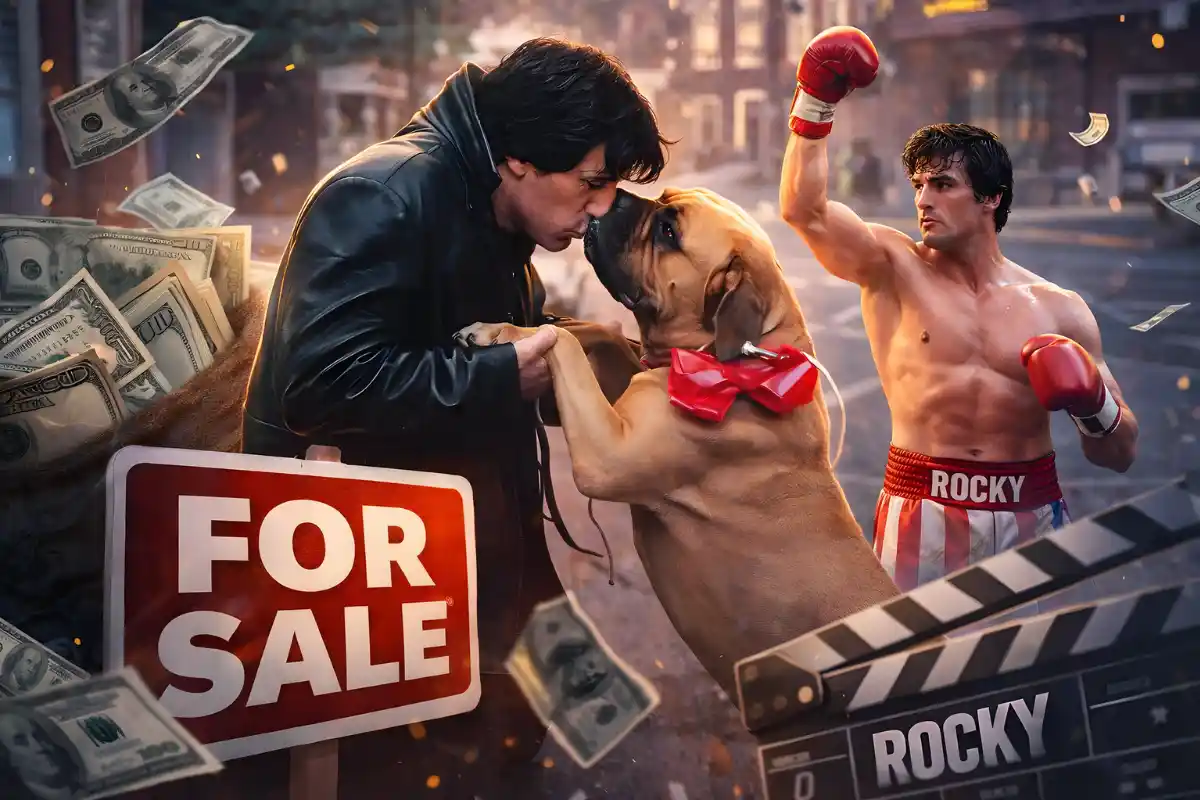
Sylvester Stallone once said he felt exactly that when he sold his dog Butkus for $40 during one of the lowest points of his life — a moment that has since become one of Hollywood’s most repeated survival stories.
The Scene
It was early 1970s New York. Money was gone. Work was scarce. Stallone was sleeping in cheap rooms, trying to make it as an actor while scraping together enough to eat. The bullmastiff at his side, Butkus, was more than a pet — he was the one constant in a life that felt like it was falling apart.
At some point, Stallone later recalled, the choice stopped being about pride. It became about survival.
He sold the dog outside a small store, unable to afford food for both of them.
And then he went home and cried.
Who + Why Now
The story has circulated for decades, but it keeps resurfacing online whenever the Rocky franchise returns to public conversation or when Stallone reflects on his early career. Social media clips, old interviews, and recent tributes have revived the tale as a symbol of grit — or, for some, as a reminder that even famous people have moments that feel painfully ordinary.
It also fits perfectly with the Rocky myth itself: the idea that success often starts with humiliation, stubbornness, and a refusal to give up.
That parallel is one reason the story refuses to fade.
The Full Story
At the time, Stallone was unknown, broke, and struggling to land steady acting work. He had small parts and bit roles, but nothing close to the breakthrough he needed. His living situation was unstable, his finances worse.
Then came a spark of opportunity.
Inspired by a boxing match between Muhammad Ali and Chuck Wepner, Stallone wrote the screenplay for Rocky in just a few days. The script quickly attracted interest. Studios saw potential. But there was a catch.
They wanted a more established actor in the lead role.
Stallone refused.
The offer on the table reportedly included more money if he stepped aside, but he held firm. He insisted on starring in the film himself, even if it meant taking less upfront. The gamble paid off. Rocky was eventually produced with Stallone as its lead, launching one of the most iconic underdog stories in cinema.
Once the deal closed and money finally arrived, Stallone’s first priority wasn’t fame or comfort. It was finding Butkus.
Tracking down the dog wasn’t simple. The new owner, aware of Stallone’s growing success, initially refused to sell. Negotiations followed. The price climbed. Eventually, Stallone bought the dog back — reportedly for a figure far higher than the original $40.
Butkus would go on to appear in Rocky and its sequel, becoming part of the film’s emotional core and cementing his place in movie lore.
Public Reaction
Online, the story lands in two very different ways.
On platforms like Reddit and TikTok, many users treat it as proof of Stallone’s loyalty and determination. Threads recount the moment as a kind of modern myth — a real-life underdog arc that mirrors the film itself. Fans often share the anecdote alongside clips of Rocky’s training scenes, framing it as evidence that the film’s emotional truth came from lived experience.
Others question the details.
Discussions frequently debate how much of the story has been shaped by time or storytelling instinct. Stallone’s brother, Frank Stallone, has publicly expressed skepticism about parts of the tale, calling certain versions exaggerated. Still, Stallone himself has repeated the core account in interviews and social media posts, reinforcing its place in his personal narrative.
The divide doesn’t weaken the story’s power. If anything, it keeps it alive.
In the age of viral content, ambiguity often fuels interest more than certainty.
Bigger Truth
There’s a reason this moment resonates beyond movie trivia. Fame tends to flatten people into headlines and box office numbers. Stories like this pull them back into human scale.
Selling a beloved dog for survival is not a glamorous origin story. It’s messy, emotional, and hard to reconcile with later success. Yet that contrast is exactly what keeps audiences hooked. It suggests that the distance between desperation and triumph can be shorter — or more fragile — than it looks.
Rocky’s fictional climb from obscurity to victory feels believable partly because its creator lived through something just as raw.
Not a boxing match.
But a choice no one wants to make.
Conclusion
Years after Rocky changed his life, Stallone still returns to the memory of that sidewalk and the dog he couldn’t afford to keep. Butkus became part of his success story, but the moment that defines it isn’t the reunion or the film credit.
It’s the quiet decision that came first.
And it raises a question that fame never fully answers: how much of a person’s past stays with them, even after the spotlight turns on?