


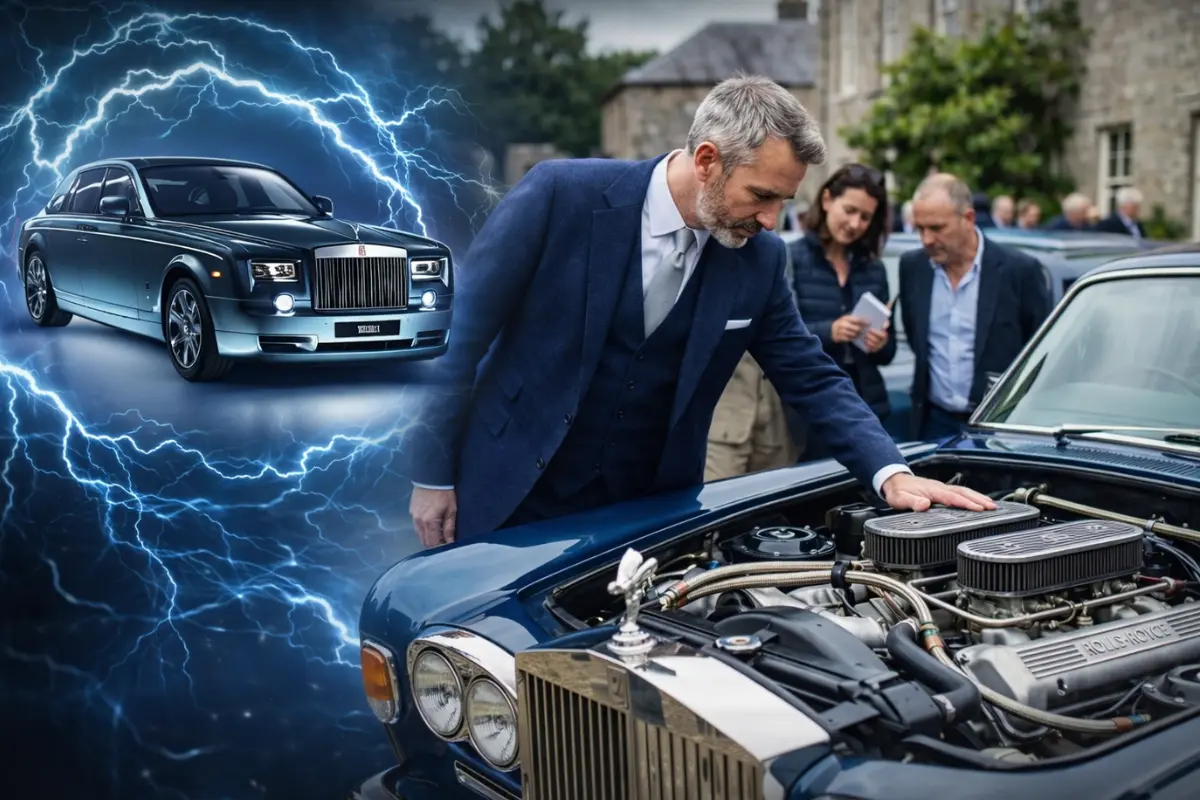
The sound is barely there—but that’s exactly the point.
For decades, the Rolls-Royce Motor Cars V12 has been known not for noise, but for silence so refined it feels unnatural. Now, just as the brand was preparing to move past it, that same engine is pulling the company back.
Rolls-Royce has quietly shifted away from its plan to go fully electric by 2030, choosing instead to keep its signature V12 alive alongside new electric models. The reason is simple: the people buying these cars don’t want to let it go.
The Surprising Fact
Most people assume electric cars are the future of luxury. Smooth, silent, effortless.
That already sounds like a Rolls-Royce.
But here’s the catch: for Rolls-Royce buyers, silence alone isn’t enough. The experience has to feel mechanical, crafted, almost alive. The V12 engine—especially the brand’s long-running 6.75-liter version—delivers that in a way batteries don’t.
And that difference matters more than any regulation.
What This Actually Means
This isn’t a full reversal. Rolls-Royce is still building electric cars, including its first EV coupe, the Spectre.
But instead of replacing gas engines entirely, the company is now doing both:
- Electric models for clients who want modern tech
- V12-powered models for those who value tradition
In plain terms, Rolls-Royce is no longer forcing the future. It’s letting its customers decide when—or if—they want it.
That’s rare in today’s auto industry.
Why the V12 Still Wins
To understand this shift, you have to understand the buyer.
Rolls-Royce customers are not typical drivers. Many own multiple homes, private jets, and entire car collections. Fuel cost is irrelevant. Charging access is irrelevant. Even driving itself is sometimes optional—many are chauffeured.
What they care about is how the car feels.
The V12 delivers something hard to explain but easy to notice:
- Power that comes without effort
- Motion that feels like floating
- A sense of craftsmanship tied to physical engineering
Inside the company, they even have a word for it: “waftability.”
Electric cars can match the smoothness. Some even exceed it.
But they don’t carry the same emotional weight.
And at this level of wealth, emotion beats efficiency every time.
The Industry Is Slowing Down Too
Rolls-Royce isn’t alone.
Across the ultra-luxury segment, brands are quietly adjusting their timelines:
- Ferrari is delaying full EV transition plans
- Lamborghini is prioritizing hybrid systems first
- Bentley has pushed its EV-only target further into the future
The pattern is clear.
Mass-market brands are racing toward electric. Luxury brands are pacing themselves.
Because their customers are different.
The Real Obstacle: Not Technology
On paper, electric cars should dominate this category. They’re quiet, powerful, and increasingly refined.
But the challenge isn’t performance. It’s identity.
Rolls-Royce doesn’t just sell transportation. It sells:
- Heritage
- Craftsmanship
- Mechanical prestige
The V12 engine represents all three.
Removing it too quickly risks turning the brand into something else entirely.
And for a company built on legacy, that’s a bigger risk than missing an EV deadline.
What People Are Saying
Online reactions reflect a split, but not the one you might expect.
On platforms like Reddit and automotive forums, many users see the move as inevitable.
Some argue electric is already superior:
“Luxury should lead innovation, not resist it.”
Others push back:
“If I’m paying that much, I want an engine—not a battery.”
One comment that kept resurfacing summed it up simply:
“A Rolls without a V12 feels incomplete.”
The tone isn’t outrage. It’s recognition.
Even people who support electric cars understand why this brand is different.
The Business Decision Behind It
At its core, this is a customer-first move.
Rolls-Royce doesn’t compete on volume. It competes on exclusivity and loyalty. Losing even a small portion of its core buyers would matter more than hitting a public sustainability target.
There are also practical factors:
- Limited EV infrastructure doesn’t affect buyers, but battery scaling at ultra-luxury levels still poses challenges
- Custom, hand-built production makes rapid platform shifts harder
- High-end clients often request bespoke features tied to traditional engineering
Keeping the V12 isn’t just emotional. It’s strategic.
Where This Leaves the Future
The shift doesn’t mean electric is off the table.
It just means the transition will be slower—and more selective.
Expect to see:
- More electric Rolls-Royce models over time
- Continued V12 production in flagship cars like the Phantom
- Possible hybrid steps bridging both worlds
For now, the future of Rolls-Royce isn’t electric or gasoline.
It’s both.
The Moment That Says It All
Picture a collector standing in a private garage, surrounded by cars worth millions.
They press a button.
The engine doesn’t roar. It hums—barely audible, perfectly smooth.
That’s the experience they’re paying for.
And for now, no battery has fully replaced it.
So the V12 stays.