

A joke got out of hand, and suddenly the internet was pointing at a map most people had never really looked at.
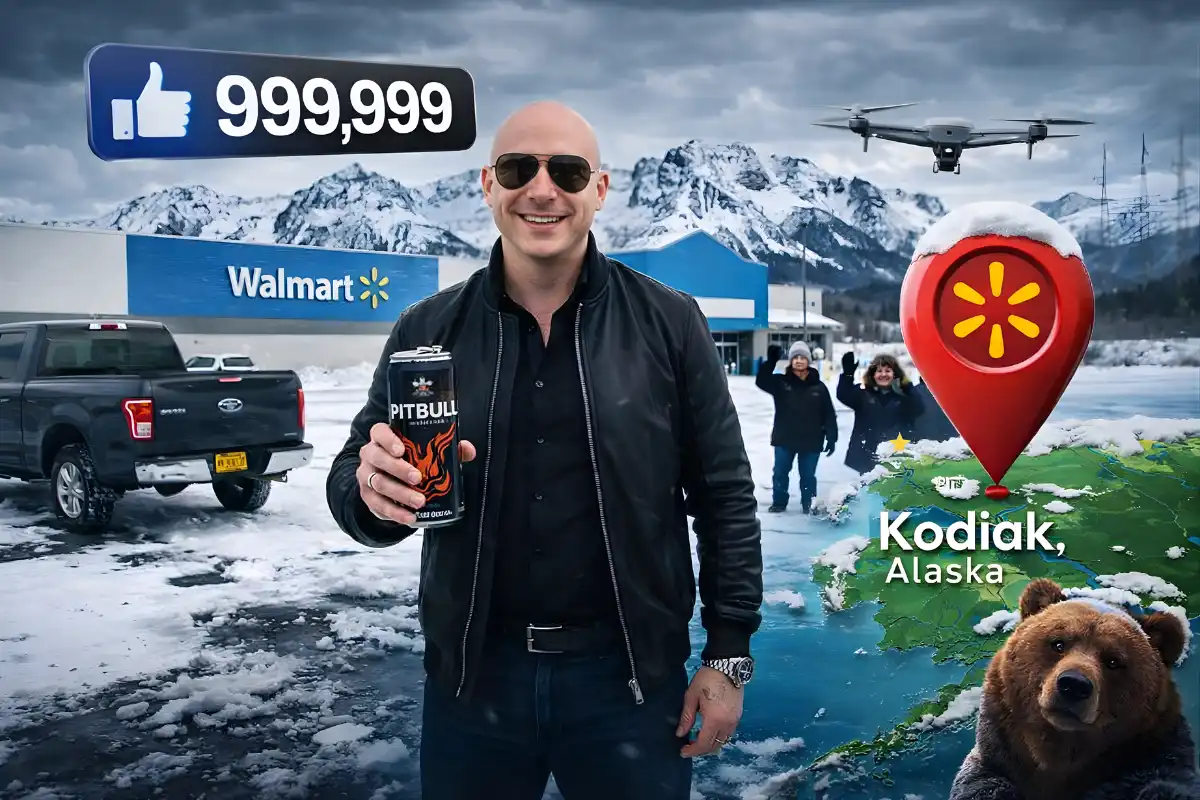
In early 2012, the Pitbull Alaska Walmart story began as a simple marketing stunt. Then Pitbull — real name Armando Christian Pérez — found himself boarding a flight to Kodiak, a remote island town, because strangers online decided it would be funny.
They voted him there on purpose.
The Scene
The wind off the water was cold, the kind that cuts through a jacket. A small crowd gathered outside a store most Americans will never visit.
Pitbull stepped out, smiling.
No complaints. No excuses.
Just a man who showed up where the internet sent him.
Who + Why Now
At the time, Pitbull was everywhere — radio hits, club anthems, brand deals. In 2012, he partnered with Walmart to promote a product called “Sheets,” an energy strip brand.
The campaign was simple: whichever Walmart store got the most Facebook “likes” would get a visit from him.
It sounded like a safe bet. Big cities. Big fan bases. Easy math.
But the internet doesn’t always play by marketing rules.
A writer from The Boston Phoenix, David Thorpe, suggested a prank: send Pitbull to the most remote Walmart possible — the one in Kodiak, Alaska.
People listened.
The Full Story
What started as a niche joke spread fast. Reddit threads picked it up. Facebook users began sharing the idea with one clear goal: push votes toward the Kodiak store.
And it worked.
The Kodiak Walmart surged in likes, beating out locations in major cities. Thousands of users joined in, not because they lived there — but because they wanted to see what would happen.
Because it was funny.
Because it was absurd.
Because it was the internet.
There was a moment when people wondered if the campaign would quietly change the rules or ignore the result. Brands often do when things go off-script.
Pitbull didn’t.
He leaned in.
Instead of backing out, he confirmed he would go. Not only that, he invited the journalist who helped spark the prank to join him on the trip.
That decision flipped the tone of the story.
What could have been a PR disaster turned into something else entirely.
When Pitbull arrived in Kodiak, he didn’t treat it like a joke. He met local residents, took photos, and spent time at the store. The visit drew attention to a place that rarely gets national coverage.
The town welcomed him warmly.
He was even given a ceremonial “key to the city,” a symbolic gesture often reserved for honored guests.
And then there was the gift.
Bear spray.
A practical tool in Alaska, where encounters with wildlife are real, not hypothetical.
It was funny. But also sincere.
For a moment, a global celebrity and a small town shared the same spotlight — and both came out looking good.
Public Reaction
The reaction online shifted almost as quickly as the vote itself.
On Reddit, threads that began as jokes turned into praise. Users who expected the stunt to collapse instead watched it play out exactly as promised.
One comment, widely shared at the time, summed up the mood: “He actually went. Respect.”
On Twitter, people posted photos from the visit and clips from interviews. The tone moved from sarcasm to admiration.
Even media outlets picked it up as a rare example of a celebrity and a brand following through on a risky campaign.
It felt different.
No damage control. No awkward apology. Just action.
Late-night hosts and comedians referenced the story as proof that sometimes the internet gets what it wants — but not always in a bad way. The joke wasn’t on Pitbull anymore.
He had taken control of it.
Bigger Truth
The Pitbull Alaska Walmart story worked because it broke an unspoken rule: big brands and celebrities usually avoid losing control.
This time, they didn’t.
The internet tried to turn a campaign into a prank. Instead, it became a moment of connection.
Pitbull’s decision to show up changed everything. It turned a potential embarrassment into a story about keeping your word — even when it’s inconvenient, even when it’s far away, even when it started as a joke.
It also revealed something about online culture.
People love to test limits. They push systems just to see what happens.
But when someone responds with honesty instead of resistance, the reaction can flip fast.
Conclusion
Back in Kodiak, the moment ended the way it began — with people watching, waiting to see what would happen next.
Pitbull showed up, smiled, and stayed true to the deal.
And just like that, the joke wasn’t really a joke anymore.
It was a reminder that sometimes the internet wins — but sometimes, someone handles it so well that it doesn’t feel like a win or a loss at all.