
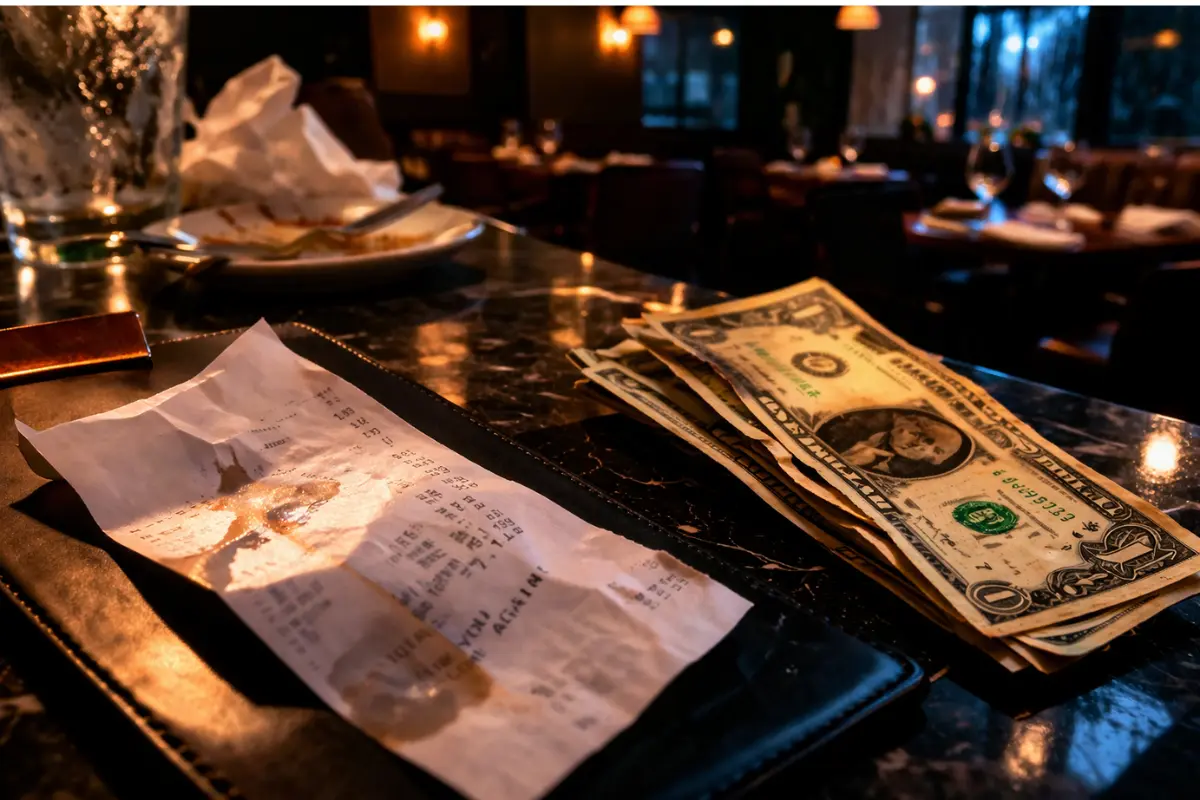
It feels strange to sit through a full meal and never reach for your wallet twice. That small, automatic moment—the pause, the mental math, the tip screen—just isn’t there in no tipping restaurants.
For some diners, that absence feels like relief. For others, it feels like something’s off.
The shift is real. A growing number of no tipping restaurants are building service into menu prices, raising them by as much as 20% to 30%, and asking customers to stop tipping entirely. The idea sounds simple: fair wages, clear pricing, no awkward decisions. But the reality has been anything but smooth.
The Server Who Didn’t Want the Change
In Austin, Texas, a 29-year-old server named Maria had been working busy dinner shifts for years. On good nights, she could walk out with $300 in tips. Weekends were even better.
Then her restaurant switched to a no tipping model.
Her hourly pay went up. Her income did not.
“I lost my best nights,” she said in a local interview. The steady paycheck sounded safer on paper, but it capped her upside. The rush, the reward for handling a packed room, the direct link between effort and earnings—it was gone.
She stayed for three months. Then she left for a restaurant that still allowed tips.
She’s not alone.
The Numbers Behind the Shift
No tipping restaurants often raise menu prices by 20% to 30% to cover wages, benefits, and taxes. A $20 entrée becomes $26. On paper, that includes service.
But many customers don’t see it that way.
They see a higher number first.
And that changes behavior.
One study discussed in Boston University research on tipping culture shows that most diners still expect to control how much they pay for service. Around 77% say service quality directly affects their tipping decisions.
That sense of control matters more than the math.
A $22 meal plus a tip feels flexible. A $27 fixed price feels expensive—even if the total cost ends up the same.
Why This Is Happening Now
The push toward no tipping restaurants didn’t come out of nowhere. It’s tied to several pressures hitting the industry at once.
First, labor costs have gone up. Restaurants are under pressure to pay higher base wages and offer more stable income.
Second, customers are tired.
“Tip fatigue” has become a real phrase. Digital screens now ask for tips at coffee counters, takeout windows, even self-service kiosks. The expectation has spread far beyond full-service dining.
A report discussed in Forbes highlighted how many customers feel tipping is “out of control,” with suggested tips climbing past 20%.
At the same time, restaurants operate on thin margins. Owners are trying to solve two problems at once: keep staff and keep customers.
Removing tips looks like a clean fix.
It rarely is.
Some high-profile restaurants that removed tipping eventually reversed the decision after seeing lower traffic, staff turnover, or customer complaints about prices.
The system is sticky because it balances three competing interests: customer perception, worker income, and business survival.
Change one, and the others react.
The Debate at the Table
Supporters of no tipping restaurants argue that the current system is flawed. It can lead to income swings, unequal pay between front and back of house, and even bias in how service is rewarded.
They also point out that in many countries, tipping is minimal. Service is included. Workers earn stable wages.
The meal ends cleanly.
Critics, many of them servers, see it differently. They argue that tips allow top performers to earn far more than a fixed wage. In busy restaurants, experienced servers can make $40 to $60 an hour during peak times.
That’s hard to replace with a salary.
Restaurant owners sit in the middle. Some want the simplicity of a no tipping model. Others say it puts them at a disadvantage when nearby competitors still show lower menu prices.
A diner comparing two menus doesn’t always calculate the final bill.
They react to the first number they see.
And that first number can decide where they eat.
The Psychology No One Talks About
This isn’t just about money. It’s about how people feel while spending it.
Tipping gives customers a sense of control. It lets them reward good service—or hold back when something feels off.
Take that away, and the experience changes.
It becomes fixed. Less personal.
For some diners, that’s a relief. No pressure, no awkward screen, no guessing what’s expected.
For others, it removes a small but meaningful part of dining out.
It also shifts responsibility. Instead of the customer deciding the reward, the restaurant sets it in advance. That can feel fair—or it can feel like a loss of choice.
Both reactions can exist at the same table.
The Gut Check Everyone Recognizes
You’re looking at a menu.
One place lists a burger at $18. Another lists it at $24, service included.
You know, logically, the totals might end up close.
But one still feels cheaper.
That feeling is hard to override.
And it’s one of the biggest reasons no tipping restaurants struggle to gain traction, even when the math works out.
People don’t just pay with numbers. They pay with perception.
Back to Maria
After leaving the no tipping restaurant, Maria returned to a traditional setup. Her income went back to fluctuating. Some nights were slow. Others made up for it.
She preferred it that way.
“It’s not perfect,” she said, “but at least I know I can earn more if I push.”
The restaurant she left still operates without tips. Prices are higher. Reviews mention the clarity—and the cost.
Both are true.
So the question sits there, unchanged: if the final bill feels higher, even when it isn’t, which system would you choose when it’s your money on the table?