


The small thing that gets taken away
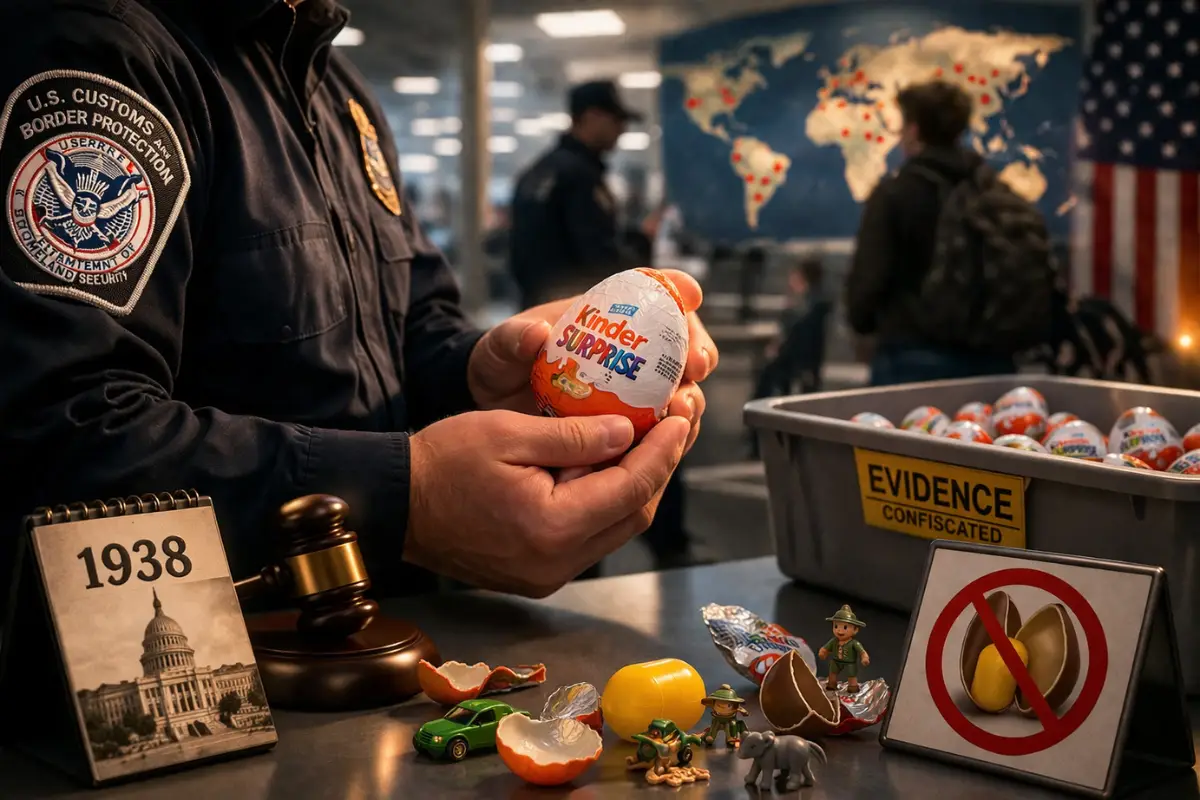
You pack a suitcase with snacks from home, thinking nothing of it. Then someone in uniform pulls out a chocolate egg like it’s a banned item.
That moment is where the Kinder Surprise ban USA story begins—not with policy, but with confusion.
Every year, thousands of these chocolate eggs are stopped at U.S. borders. In some reported years, more than 60,000 were seized by customs agents, according to U.S. Customs and Border Protection data cited in multiple travel advisories and news reports.
It sounds minor. It doesn’t feel minor when it happens to you.
A chocolate egg that breaks a federal rule
The reason goes back much further than the candy itself.
Kinder Surprise eggs—created in Italy in 1974 by Ferrero—contain a small toy sealed inside a hollow chocolate shell. They are sold across Europe, Canada, Latin America, and much of Asia. For many families, they are a normal childhood treat.
In the United States, they fall under a law written decades earlier.
The Federal Food, Drug, and Cosmetic Act of 1938 bans any food that contains a “non-nutritive object” embedded inside it. The intent was simple: prevent choking hazards hidden inside food.
Kinder eggs weren’t the target. They just fit the rule.
That’s why customs officers are allowed to confiscate them on sight.
And sometimes, fine travelers for bringing them in.
The moment at the checkpoint
Most people don’t know the rule until it’s too late.
Travel forums and airport stories repeat the same scene: a parent arriving from Canada or Europe, a bag opened at inspection, and a handful of chocolate eggs pulled out like prohibited goods.
Some laugh it off.
Others don’t.
In a few widely shared cases, families reported being warned about fines reaching up to $2,500 per violation, though enforcement varies and many cases end with simple confiscation.
Still, the tone can feel serious.
It’s chocolate. But the process doesn’t treat it that way.
Why the U.S. treats it differently
The difference comes down to how countries think about risk.
In Europe, Kinder Surprise eggs are legal but regulated. They carry age warnings, and the toy capsule must meet strict size and safety rules.
The assumption is that parents will supervise.
In the United States, the approach is stricter. The idea is to remove the risk entirely rather than manage it.
If something inside food could cause harm—even rarely—it is not allowed.
That’s why the rule is broad.
And why it still applies today.
The FDA has maintained that embedded objects inside edible products pose a choking hazard, especially for young children who may bite into the item without expecting anything inside.
The workaround that changed everything
Ferrero didn’t walk away from the U.S. market.
They adapted.
In 2018, the company introduced Kinder Joy, a version designed specifically to meet U.S. safety standards. Instead of hiding the toy inside the chocolate, the product splits into two halves: one side with a toy, the other with a creamy treat.
Same idea.
Different structure.
Fully legal.
Today, Kinder Joy is widely sold in American stores, while the original Kinder Surprise remains restricted.
It’s a small design change that turned a banned product into a compliant one.
Online reactions: confusion, jokes, and debates
The ban has taken on a life of its own online.
On Reddit and TikTok, Kinder eggs often appear in lists of “things banned in the U.S. but normal elsewhere.” Posts comparing them to legal but less healthy foods tend to gain traction quickly.
The tone shifts between humor and disbelief.
One recurring joke shows up again and again: people pointing out that something as simple as a chocolate egg is treated like contraband at the border.
Late-night comedians have used it too, framing it as an example of strange regulatory lines.
At the same time, some parents support the rule.
They point to choking risks and argue that the law removes uncertainty.
Others say it should be a choice, not a ban.
The split is clear—but rarely heated.
It’s more confusion than anger.
The strange image that sticks
A customs officer holding a Kinder egg.
That’s the image people remember.
Not the law. Not the policy. The moment.
It feels out of proportion, even when the reasoning is explained.
And that’s why the story keeps resurfacing.
It’s simple. It’s visual. And it sits right at the edge of what people expect from everyday rules.
A detail that makes it real
The number stands out: over 60,000 eggs seized in a single year.
Not once. Repeatedly, across different reports and enforcement periods.
That means thousands of small, ordinary moments—bags opened, items removed, brief explanations given.
It’s not rare.
It’s routine.
Why people keep sharing it
Because it feels like a mismatch.
A childhood treat turned into a regulated item.
A normal habit in one country becoming a violation in another.
It hits that small nerve people recognize: the moment when something familiar suddenly doesn’t fit.
That’s enough to make it travel.
The last moment at the counter
Back at the airport, the scene ends quickly.
The eggs go into a bin. The traveler zips the bag shut. The line moves forward.
No argument. No long explanation.
Just a quiet adjustment to a rule most people didn’t know existed.
And for a second, it lingers.
Not because it’s serious.
Because it feels strange.