


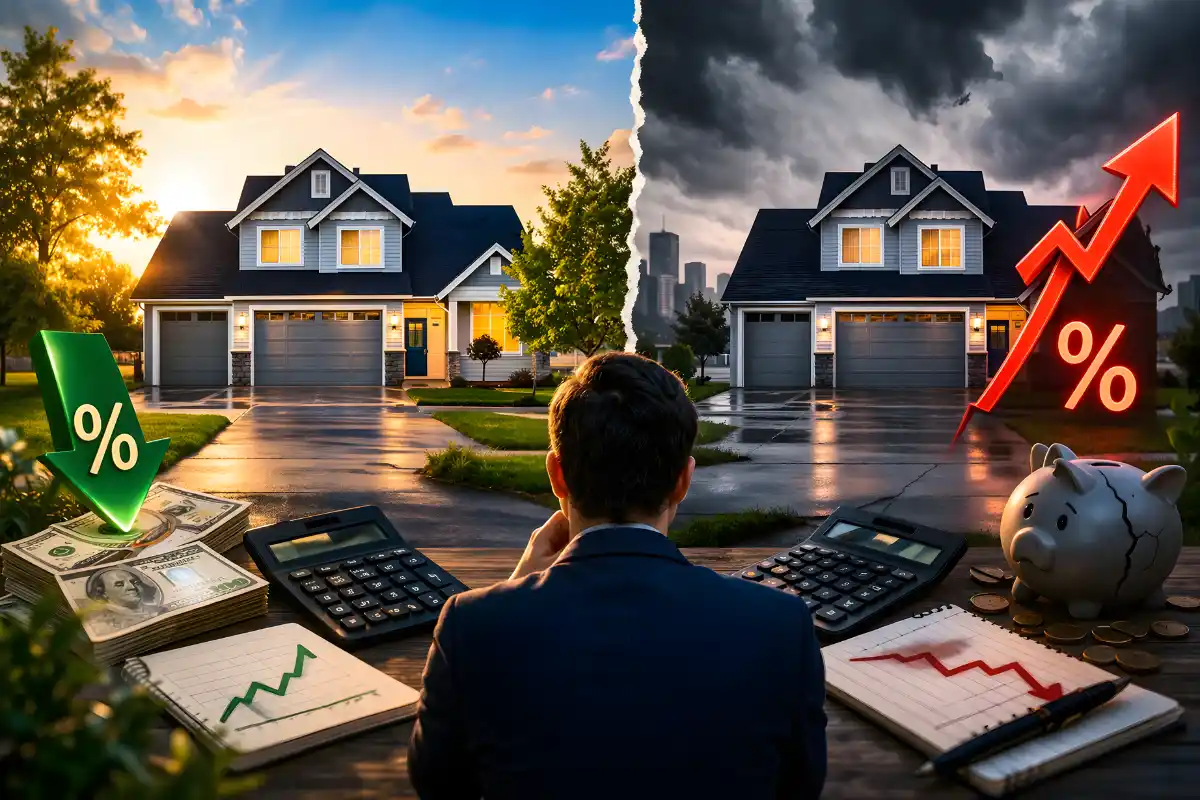
The number hits before the dream even has a chance to form. The housing affordability crisis doesn’t show up in listing photos—it shows up in the monthly payment that quietly decides whether a family moves forward or walks away.
For many buyers, the question isn’t “Do I want this house?”
It’s “Can I survive this payment?”
A Buyer Who Did the Math
In Phoenix, a 34-year-old nurse spent most of 2021 browsing homes in the $450,000–$500,000 range. Back then, her lender quoted her a payment just under $1,700 a month. It felt tight, but possible.
She waited.
By 2024, the same homes were still around the same price. But when she ran the numbers again, the monthly payment came back over $2,500.
Same house. Same salary range. Completely different decision.
She didn’t stop wanting a home.
She stopped being able to justify the cost.
The Core Math That Changed Everything
At the center of the housing affordability crisis is a simple shift:
- A $500,000 home at 3% interest → about $1,686/month
- The same home at 6.5% → about $2,528/month
That’s an $842 jump every month.
Over 30 years, that difference adds up to more than $300,000 in extra payments.
Nothing about the house improved.
Nothing about the buyer changed.
Only the cost of borrowing moved—and it moved fast.
According to National Association of Realtors, affordability has dropped to levels not seen in decades, with monthly payments rising far faster than incomes.
And that gap is where buyers are getting stuck.
Why This Is Happening
The housing affordability crisis didn’t come from one cause. It came from several forces stacking on top of each other.
First, mortgage rates surged after 2021 as the Federal Reserve raised interest rates to slow inflation. Mortgage rates climbed from around 3% to over 6% in a short time.
Second, home prices didn’t fall enough to offset those higher rates. Limited housing supply kept prices elevated. Many homeowners locked into low rates during 2020–2021 chose not to sell, reducing available inventory.
This created what analysts call the “lock-in effect.”
Millions of homeowners are sitting on mortgages below 3%. Selling would mean buying again at double the rate.
So they stay.
That keeps supply tight.
Which keeps prices high.
Which keeps payments out of reach.
Third, wages haven’t kept up. Even with income growth, it hasn’t matched the jump in monthly housing costs.
The result is a squeeze from both sides: higher borrowing costs and still-high home prices.
The Debate Around What Comes Next
Some analysts argue the market is simply “paused,” not broken. They point to strong demand still waiting on the sidelines—buyers who will return if rates fall.
Others say this is a deeper shift.
On financial forums and Reddit threads with hundreds of replies, a common theme appears: buyers feel priced out not by home values, but by financing.
“We’re not priced out of homes—we’re priced out of loans,” one widely shared comment reads.
Economists at Redfin and Zillow note that even small rate changes can swing affordability dramatically. A 1% increase in mortgage rates can raise monthly payments by roughly 10%.
That sensitivity is why demand drops quickly when rates rise—and why it could return just as fast if rates ease.
Still, there’s no agreement on timing. Some expect gradual relief. Others expect a longer period of stagnation.
Meanwhile, builders are offering incentives like rate buydowns just to keep deals moving.
The market hasn’t crashed.
It has slowed to a crawl.
The Quiet Reality Buyers Feel
If you’ve ever opened a mortgage calculator and watched the number climb as you adjusted the interest rate, you already understand this crisis.
It’s not abstract.
It’s personal.
You start with a price that seems manageable. Then the payment appears—and suddenly the math doesn’t work anymore.
People aren’t walking away because they don’t want homes.
They’re walking away because the monthly cost doesn’t fit into a real-life budget that includes groceries, gas, childcare, and everything else.
And that’s the part that doesn’t show up in headlines.
Closing Moment
Back in Phoenix, that same nurse still checks listings now and then. The homes haven’t changed much. The neighborhoods still feel familiar.
But the numbers are different.
Every time she runs them, the answer comes out the same.
Not yet.
And if the payment on the same house can decide everything, how many others are quietly reaching that same conclusion right now?