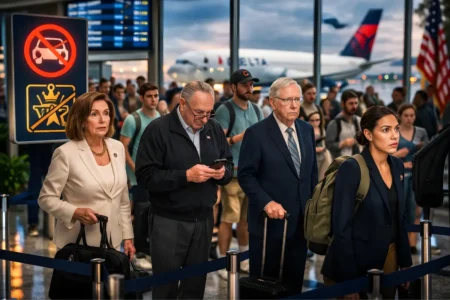


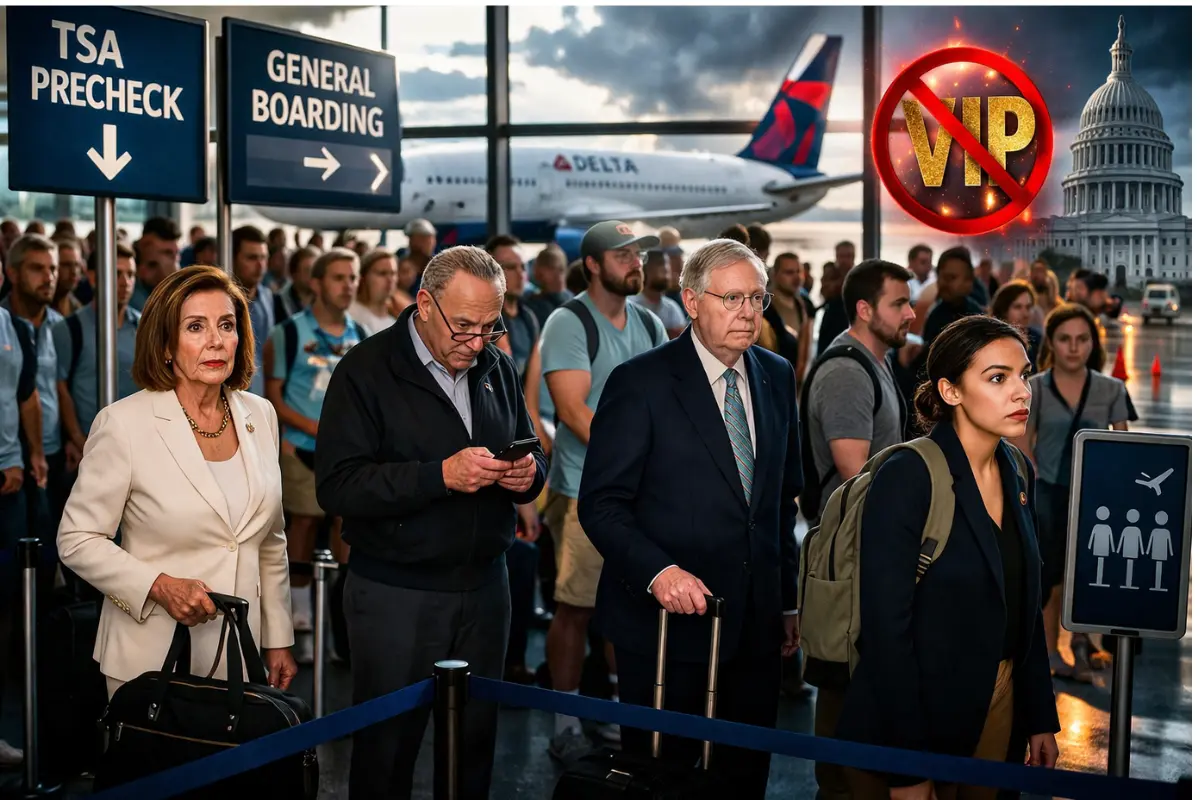
There’s a certain kind of frustration that hits when the line doesn’t move.
It’s that slow shuffle forward, carry-on digging into your shoulder, shoes half off, wondering why this always takes so long. For once, that feeling isn’t limited to everyday travelers. The phrase Congress Airport Privileges is trending because lawmakers are now standing in the same airport security lines as everyone else.
The reason is simple. During a U.S. government shutdown, staffing shortages have stretched airport security thin. As a result, airlines like Delta Air Lines have paused special escort services for members of Congress. No shortcuts. No fast lanes. Just the same process millions deal with daily.
And yes, that includes waiting.
The Moment It Became Real
At one of Washington’s busiest airports, a congressional staffer reportedly found themselves inching forward in a standard TSA line, surrounded by families, business travelers, and tired commuters.
No escort. No side entrance. No workaround.
Just another passenger checking the time and hoping the line moves faster.
That small shift is what turned this into a story people couldn’t ignore. For years, lawmakers have had quiet access to extra help at airports — not always official perks, but widely known assistance tied to tight schedules and security needs.
Now, at least for the moment, that layer is gone.
What Changed — And Why It Matters
The change ties directly to the ongoing United States government shutdown.
When funding pauses, agencies like the Transportation Security Administration keep operating, but under strain. TSA agents are required to work, often without immediate pay, and that can lead to staffing gaps and longer wait times.
In past shutdowns, some airports reported security lines stretching beyond an hour during peak travel times. In extreme cases, certain checkpoints had to close temporarily due to staff shortages.
Now imagine that same delay — but for people who usually don’t experience it.
That’s the shift.
It’s not just about lines. It’s about perspective.
Why This Situation Exists
Airport security has always been a balancing act between safety, staffing, and volume. Add a government shutdown, and that balance gets shaky fast.
Here’s what’s happening behind the scenes:
- TSA agents continue working but may face delayed paychecks
- Absentee rates can rise during extended shutdowns
- Passenger volume doesn’t slow down, especially in major hubs
- Airlines and airport staff lose flexibility to provide extra services
Airports like Ronald Reagan Washington National Airport and Dulles International Airport are especially sensitive to these changes because of their heavy mix of government and business travel.
When staffing tightens, optional services are often the first to go.
That includes VIP-style assistance.
The Debate People Are Having
Online, the reaction has been immediate — and divided.
On platforms like Reddit and X, many users are framing this as a rare moment of fairness. Threads with hundreds of replies focus on the idea that decision-makers are finally seeing the same system they help fund and regulate.
Some comments lean blunt: if you write the rules, you should live with them.
Others push back, pointing out that these escorts often exist for logistical and security reasons, not just comfort. Lawmakers move on tight schedules, sometimes across multiple cities in a single day, and delays can ripple into policy work.
Both points land.
But the tone online leans heavily toward one idea: this is what normal travel feels like.
And it’s not always smooth.
The Real-Life Connection
If you’ve ever stood in a security line watching the clock tick closer to boarding time, you already understand the stakes.
It’s not just inconvenience.
It’s missed flights, added stress, and the feeling that the system isn’t built with you in mind.
Now, at least temporarily, that experience is shared.
No priority lane.
No quiet bypass.
No quick fix.
Just the same wait.
That’s why this story is spreading. Not because of policy details, but because of recognition. People see themselves in it.
The Human Side of the Story
Back in that airport line, the staffer checks their watch again.
A family ahead is reorganizing bags after being told to remove electronics. Someone behind is sighing, loudly. The line moves a few steps, then stops.
Nothing dramatic happens.
And that’s the point.
It’s ordinary.
For millions of travelers, this is just part of the day. Something you plan around, complain about, and eventually accept.
For those used to moving faster, it feels different.
Closer. Slower. More real.
What This Moment Reveals
The conversation around Congress Airport Privileges isn’t really about airports.
It’s about access.
Who gets it, who doesn’t, and what happens when that gap disappears — even briefly.
Because when systems strain, they don’t pick sides.
They just slow everyone down.
And for a moment, everyone stands in the same line.
So the real question isn’t whether this change will last.
It’s what happens after things go back to normal — and whether standing in that line changes how it’s seen next time.