


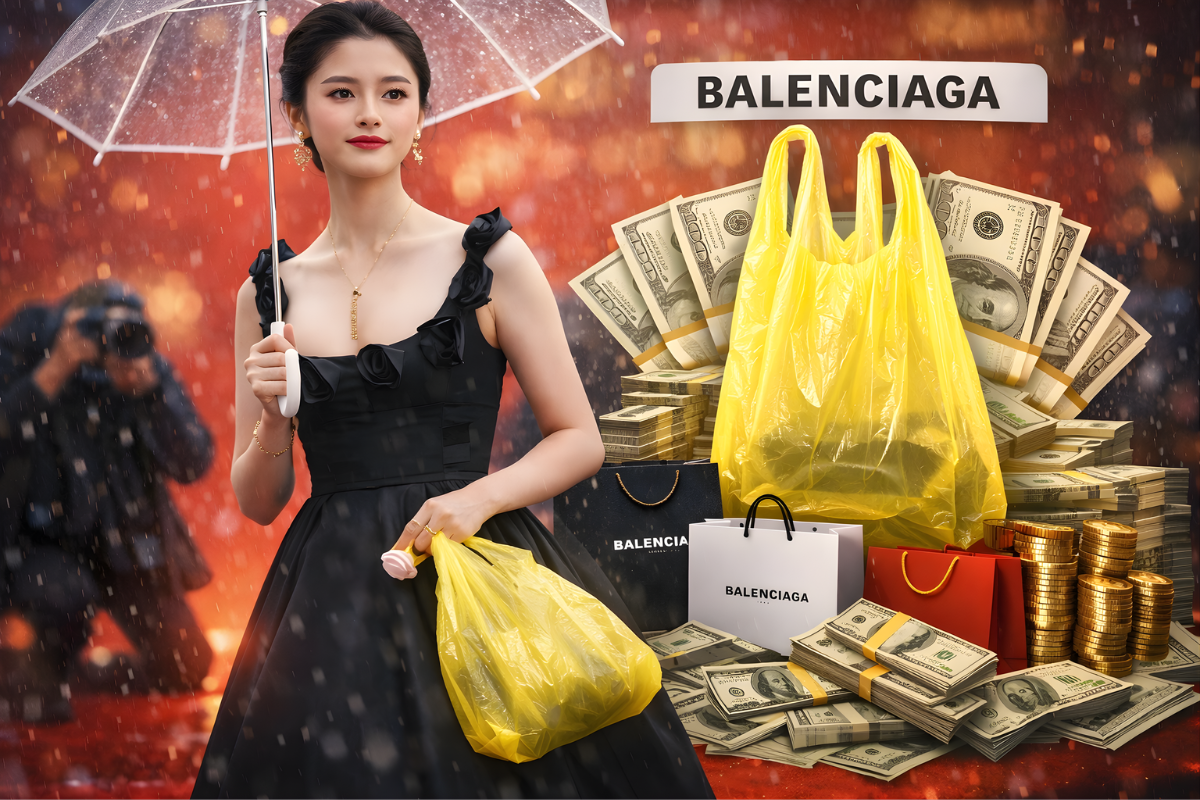
The flash of camera lights, the hush of a red carpet crowd, and then the odd jolt of confusion — because the Balenciaga trash bag in her hand didn’t look like luxury at all.
Zhang Jingyi stepped forward under a clear umbrella, the yellow pouch crinkling at her side. The actress had worn couture before. She had drawn eyes before. But this time, the conversation wasn’t about her dress.
It was about what she was carrying.
The Scene That Set It Off
Rain fell lightly as photographers called her name. Zhang Jingyi moved with calm, measured grace, dressed in a black gown that fit the formal tone of the event. Then someone noticed the bag.
It looked like something you’d carry out to the curb.
A thin, wrinkled shape, bright and unmistakably plastic in spirit. The moment froze in photos that spread online within hours. Soon, viewers learned the detail that turned curiosity into global chatter: the Balenciaga trash bag cost around $1,790.
That contrast — elegant setting, ordinary-looking object — was the spark.
Who She Is and Why This Went Viral
Zhang Jingyi has built a rising profile in Chinese film and television, often praised for her poised public image and fashion choices. Her appearances at events tend to generate style coverage in entertainment media and fashion pages alike.
This time, timing mattered.
Luxury fashion had already been under scrutiny for its pricing and symbolism, especially as inflation and living costs weighed on everyday consumers. A design that mimicked disposable household items became the kind of visual shorthand that travels fast online.
It was simple enough to understand at a glance. That made it easy to share.
The moment landed on social platforms in China first, then rippled outward to Western audiences, where the Balenciaga trash bag became a meme, a debate topic, and a punchline all at once.
The Full Story Behind the Bag
Balenciaga introduced the leather “Trash Pouch” concept as part of a broader creative push toward ironic design. The brand’s recent collections have often taken familiar objects — grocery totes, worn shoes, packing materials — and recast them as luxury goods.
In this case, the bag was made from high-grade calfskin leather and shaped to mimic the folds and texture of a plastic liner. It came in several colors, but the yellow version drew the strongest reaction because it looked closest to real household waste bags.
Fashion critics have framed the design as commentary on consumption and value. Some point to the brand’s artistic director’s long-standing interest in visual provocation. Others argue that such pieces function mainly as attention drivers in a crowded luxury market.
For Zhang Jingyi, the bag was part of a styled ensemble, not a statement she publicly explained. Yet the images placed her at the center of a wider cultural argument.
Luxury labels have long experimented with contrast — turning the mundane into status symbols. This particular example simply made that contrast harder to ignore.
And harder to ignore meant harder to stop talking about.
Public Reaction Across Platforms
On Weibo, users compared the bag to grocery store rolls costing a few dollars. Posts with side-by-side photos drew tens of thousands of shares. The tone ranged from playful disbelief to sharp criticism about what luxury should represent.
TikTok creators in the United States staged skits with real trash liners styled as high-end accessories. A Reddit thread with hundreds of replies debated whether irony itself had become the new form of branding.
One common refrain echoed across languages: if you have to explain the joke, is it still fashion?
At the same time, some influencers defended the design as wearable art, arguing that fashion thrives on discomfort and challenge. They saw the Balenciaga trash bag as part of a long tradition of avant-garde experimentation.
The divide wasn’t neat or predictable. It rarely is when taste and status collide.
What This Moment Says About Luxury Today
Luxury fashion has always walked a line between aspiration and abstraction. The Balenciaga trash bag sharpened that line into something visible enough for the public to debate in real time.
For brands, viral attention can translate into cultural staying power. For consumers, the reaction often reveals deeper feelings about money, identity, and authenticity. When a single accessory triggers a flood of commentary, it signals that fashion is functioning as a mirror.
Some see satire. Others see excess.
The truth may sit somewhere between, shaped by the context each viewer brings.
Zhang Jingyi did not invent the concept, yet her appearance provided the stage where the idea met a global audience. In that sense, the red carpet became less about style and more about symbolism.
One accessory. One price tag. A cascade of questions.
Returning to the Moment
Under the umbrella, she paused for one more photo. The yellow pouch hung at her side, silent and oddly loud at the same time.
A few seconds later, she moved on.
The cameras stayed fixed on the bag.