

Last night I was half-watching TV, half-scrolling my phone, when I saw it: “Bad Bunny breaks Michael Jackson’s Super Bowl record.” I froze. That’s a big claim. If you grew up hearing about Michael Jackson’s 1993 halftime show like it was sports history class, that number — 133.4 million viewers — sticks in your brain.
So I did what we all do. I opened Google. Then another tab. Then I texted a friend. Because if Bad Bunny really beat that record, that’s huge.
Here’s what I found.
The Quick Answer
No, he didn’t beat Michael Jackson’s U.S. TV record.
According to Nielsen ratings:
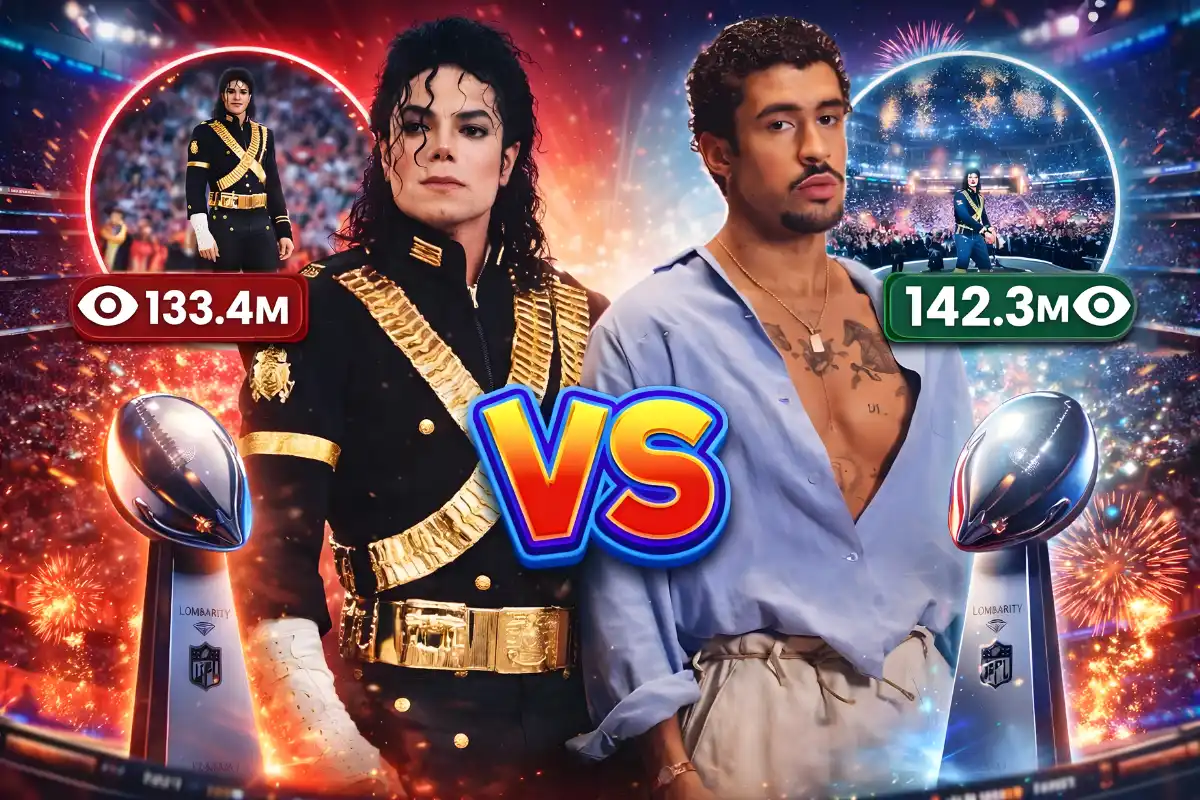
- Michael Jackson (1993): 133.4 million viewers
- Kendrick Lamar (2025): 133.5 million viewers
- Usher (2024): 129.3 million viewers
- Bad Bunny (2026): 128.2 million viewers
That puts Bad Bunny at fourth place for U.S. broadcast viewership.
So if you’re asking, “Did he pass 133.4 million on live TV?” The answer is no.
But the story doesn’t stop there.
Why People Think He Broke It
Here’s where things got messy online.
Within 24 hours of the show, reports said:
- About 4 billion social media views
- More than half of those from outside the U.S.
- Big jumps in music streams
- Record Spanish-language Super Bowl numbers on Telemundo
Those numbers are real. But they’re not the same as Nielsen TV ratings.
One fan wrote:
“He just made history.”
Another replied:
“MJ still holds the crown.”
And I get both sides.
Why Michael Jackson’s Number Still Matters
Michael Jackson’s 1993 show changed halftime forever.
Before that:
- Ratings sometimes dipped at halftime.
- The show wasn’t the main event.
- It wasn’t must-watch TV.
After that performance? Everything changed.
He stood there in silence for almost 90 seconds while the crowd screamed. That clip still floats around online today. It turned halftime into a headline.
So when people defend that 133.4 million number, they’re not just defending math. They’re defending history.
The Big Game Context
Super Bowl LX itself pulled in about 124.9 million viewers across NBC, Peacock, Telemundo, NFL+, and other platforms.
At one point during the game, viewership peaked at 137.8 million. That’s the highest peak ever recorded.
So even though Bad Bunny’s halftime show averaged 128.2 million on U.S. TV, it happened during one of the biggest Super Bowls ever.
That matters.
The Language Factor
This part stood out to me.
Bad Bunny performed mostly in Spanish.
That’s huge for a Super Bowl halftime show.
Telemundo saw record numbers for a Spanish-language broadcast. Social media lit up. People who don’t usually watch the NFL were suddenly tuning in.
I saw one meme that said:
“Me after halftime:
Hola. I speak Spanish now.”
It was silly. But it showed how big the moment felt.
Fans vs. Non-Fans
The internet split fast.
Fans said:
- “This is culture.”
- “He brought the world to the Super Bowl.”
- “Global star energy.”
Critics said:
- “TV numbers are what count.”
- “Social views aren’t the same.”
- “Michael Jackson did it first.”
And then there were people like me just watching the argument unfold with popcorn.
Why This Debate Feels Bigger Than Numbers
We don’t watch TV the way we did in 1993.
Back then:
- No YouTube clips.
- No TikTok reactions.
- No instant global comments.
- No second screen in your hand.
Now?
- People stream.
- They replay.
- They clip.
- They share.
- They argue in real time.
So what does “most watched” even mean anymore?
Is it live TV only?
Is it global views?
Is it total plays across platforms?
There isn’t one simple answer.
The Streaming Era Reality
Here’s something I keep thinking about.
Pulling 128 million live viewers today might be harder than pulling 133 million in the 90s. Media is split. People have more options. Fewer people watch anything live.
So being fourth on that list in 2026? That’s not small.
It’s elite.
And the digital side tells another story. Billions of social impressions. Huge spikes in music streams. Global chatter.
That kind of reach didn’t exist in 1993.
The Side Stories
Of course, the internet added drama.
- Bad Bunny wiped his Instagram shortly after the show.
- Meme pages made “MJ vs. Bad Bunny” graphics within minutes.
- Comment sections turned into music debates.
- Some people tried to turn it into a culture fight.
That’s Super Bowl week. It’s never just football.
So What’s the Truth?
Here’s the clean version.
Did Bad Bunny beat Michael Jackson’s 133.4 million live U.S. TV record?
No.
Did he deliver one of the biggest halftime shows in modern history?
Yes.
Did he dominate online and across global platforms?
Absolutely.
Both things can be true.
CONCLUSION
After I closed all my tabs and finally finished reading through the numbers, I realized this debate isn’t really about who “won.”
It’s about eras.
Michael Jackson defined one moment in time.
Bad Bunny defined another.
Different tools. Different audiences. Different rules.
But here’s what hasn’t changed: over 128 million people still sat down to watch halftime.
In a world where attention is split a hundred ways, that still feels big.
And maybe that’s the real headline.