


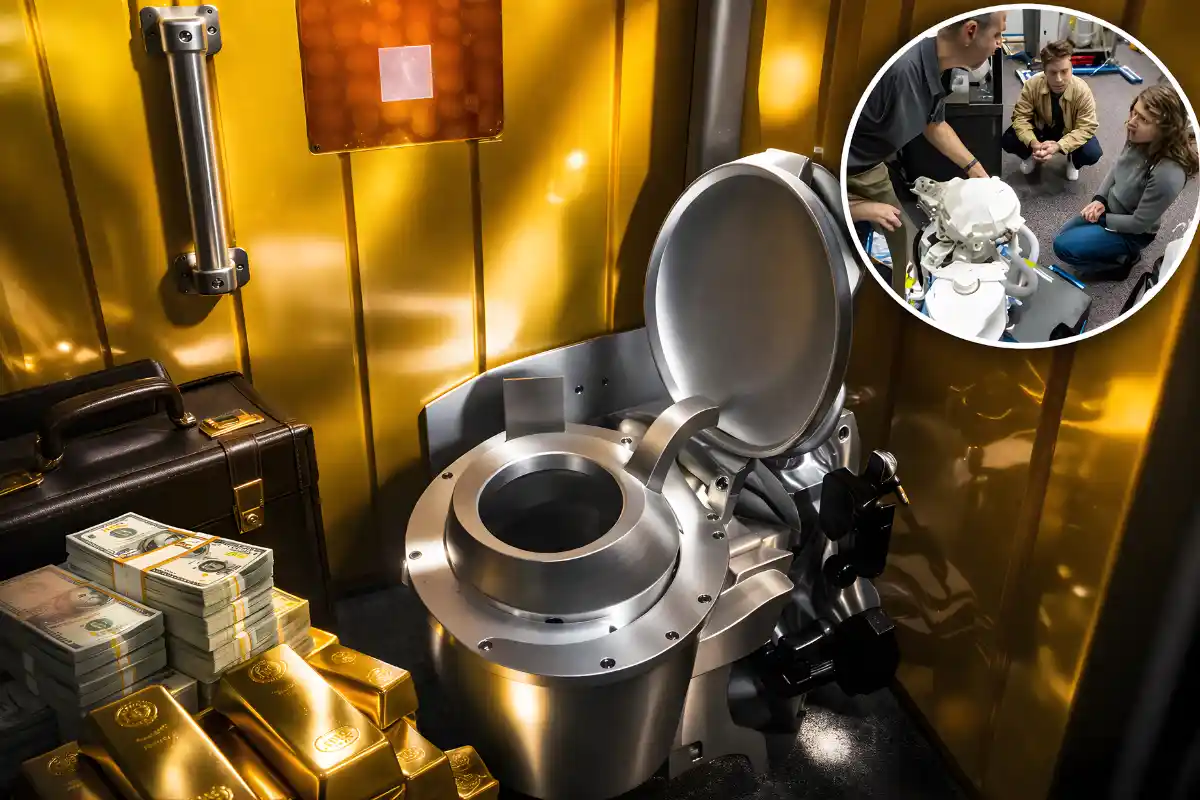
It’s the kind of number that makes you pause mid-scroll and read it again. The Artemis II toilet cost—reported at around $23 million—sounds less like a bathroom upgrade and more like the price of a small neighborhood.
But this isn’t a bathroom anyone will ever casually walk into. It’s part of NASA’s Orion spacecraft, built for a mission that will carry astronauts around the Moon for the first time in over 50 years. And for anyone wondering why something as ordinary as a toilet carries that kind of price tag, the answer starts far from Earth—and even farther from anything we’d call normal plumbing.
The One Detail Most People Miss
Most people see “$23 million toilet” and stop there.
What gets lost is that this system isn’t just a toilet. It’s a fully engineered waste management system designed to work in zero gravity, where nothing falls, everything floats, and a small failure can quickly turn into a serious problem inside a sealed spacecraft.
NASA has dealt with this before.
During the Apollo missions, astronauts didn’t have a toilet at all. They used plastic bags attached to their bodies, then manually mixed in disinfectant to prevent bacterial growth. It worked—but barely. Transcripts from Apollo 10 even captured astronauts reacting to floating waste inside the cabin.
That memory still hangs over every new design.
What the Artemis II Toilet Actually Does
The system aboard Artemis II is built to solve decades of problems in space sanitation. Instead of relying on gravity, it uses controlled airflow to pull waste away from the body and into sealed storage.
That alone requires precision.
The system separates liquid and solid waste using different airflow paths, making it more efficient and more hygienic than older designs. It’s also built with durable materials like titanium to handle extreme conditions—radiation, pressure changes, and long-term use without maintenance.
And it has to work every time.
There’s no calling a plumber in orbit.
Why the Price Climbs So High
The number that grabs attention—$23 million—includes far more than the hardware itself.
It covers years of research, testing in simulated zero gravity, safety backups, and integration into the Orion spacecraft. According to NASA, systems like this must meet strict reliability standards because failure isn’t just inconvenient—it can disrupt an entire mission.
A 2020 NASA report on its Universal Waste Management System showed how even small improvements required extensive testing, including alignment training and airflow calibration to ensure proper use in microgravity.
That level of precision adds cost quickly.
And unlike everyday products, there’s no mass production to spread those costs out.
The Internet Reaction
The number didn’t stay quiet.
On platforms like Reddit and X, the Artemis II toilet cost quickly became a talking point, often framed in comparison to everyday expenses. Threads with thousands of replies focused less on engineering and more on the contrast between space budgets and daily life.
“How is a toilet $23 million when people can’t afford rent?” was a common theme.
Another frequent reaction: disbelief mixed with humor.
“Imagine missing the target on a $23M toilet.”
Even late-night comedians picked it up, turning it into a punchline about the “most expensive bathroom break in history.”
But not everyone dismissed it.
Some users pushed back, pointing out that space systems are fundamentally different from anything on Earth. As one widely shared comment put it, “You’re not paying for porcelain. You’re paying for something that works where gravity doesn’t exist.”
That divide—between sticker shock and technical reality—kept the conversation going.
The Bigger Cost Question
Behind the jokes is a real question about spending.
NASA’s Artemis program is a multi-billion-dollar effort aimed at returning humans to the Moon and eventually preparing for missions to Mars. Every component, no matter how small it sounds, plays a role in making long-duration space travel possible.
Sanitation is part of that.
Poor waste systems can affect crew health, morale, and mission safety. On the International Space Station, past toilet failures have forced astronauts to rely on backup systems, including wearable options that no one prefers.
Fixing that isn’t just about comfort.
It’s about making sure astronauts can function normally in an environment where even simple tasks become complex.
Why It Feels So Personal
Still, it’s hard to ignore the number.
Because it lands in a very human place.
If you’ve ever looked at your monthly bills and tried to make things stretch, $23 million for anything feels distant, almost unreal. A toilet especially. Something so ordinary, so taken for granted, suddenly carries a price that could fund entire neighborhoods.
That’s why the story sticks.
Not because people don’t understand engineering—but because they understand what that number means in their own lives.
The Mission Behind It
Artemis II is set to be the first crewed mission of NASA’s Artemis program, sending astronauts around the Moon before future missions attempt a landing.
Everything on board has to work flawlessly.
Including the part no one wants to think about.
The toilet may not be the headline NASA expected, but it highlights a truth about space travel: even the most basic human needs become engineering challenges when you leave Earth.
And solving those challenges doesn’t come cheap.
One Last Reality Check
Back inside the Orion capsule, the system will sit quietly, doing its job without ceremony.
No headlines. No jokes. No second chances.
Just a piece of equipment that has to work every single time.
And for the people on board, that’s worth more than the number attached to it.
So the next time the Artemis II toilet cost comes up, the question isn’t just why it’s so high.
It’s what happens if it doesn’t work.