
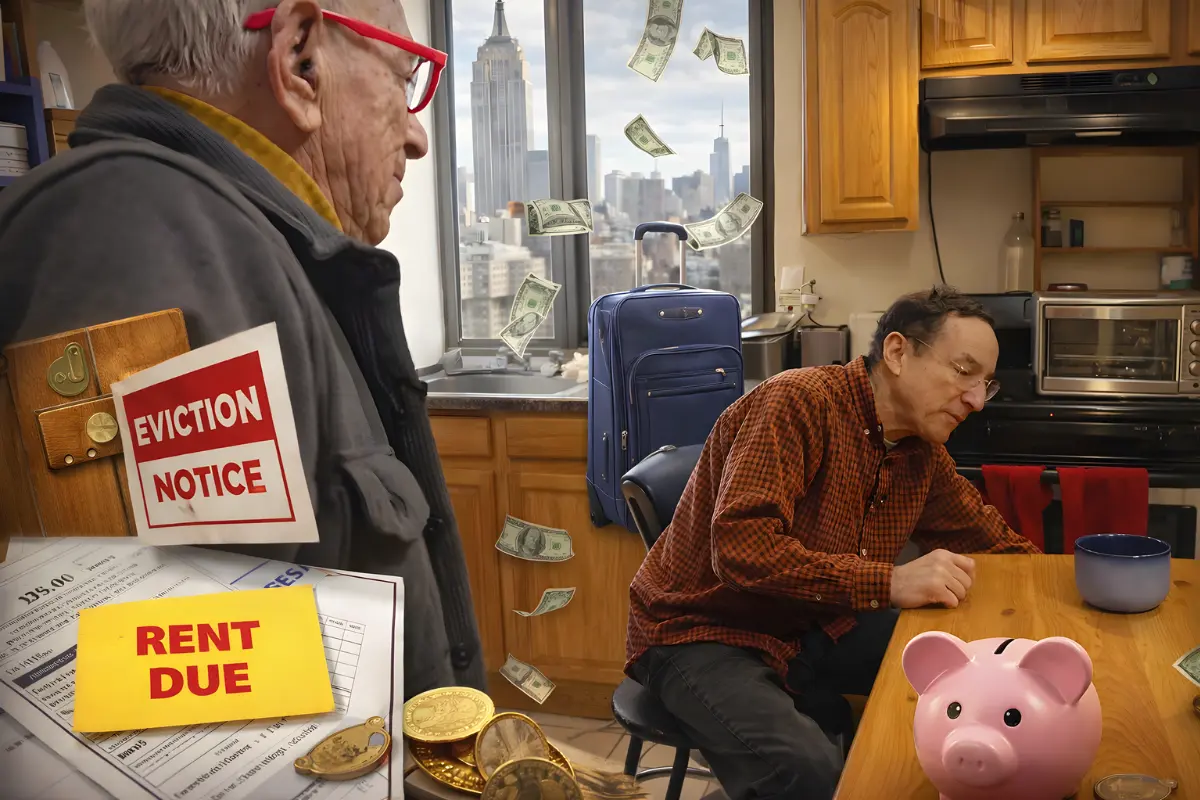
At 87 years old, Alan Ferber cannot afford his New York City rent on his own. He shares a roughly $2,000-a-month apartment with 69-year-old Daniel Yafet. Split in two, the rent becomes manageable. Alone, it would not be. Ferber works part-time. On a fixed income, he has said he could not stay in the city without a roommate. His situation is not rare. It is a clear example of the growing elderly housing crisis in the United States.
A Shared Apartment at 87
Ferber and Yafet were matched through a nonprofit home-share program that connects older adults who want to share housing costs. They are not related. They share expenses, space, and daily routines.
Yafet has said plainly that without splitting rent, staying in New York after retirement would not be realistic. Ferber, at 87, still works part-time to help cover his share. That detail alone raises a simple question: why does someone in their late 80s still need extra income just to afford housing?
The answer lies in the numbers.
The Numbers Behind the Elderly Housing Crisis
More than 1 million Americans age 65 and older now live with unrelated roommates, according to the Harvard Joint Center for Housing Studies. That figure has increased about 16% since 2019.
At the same time:
- Rents in the 50 largest U.S. cities have risen about 41% between 2020 and 2025.
- In New York City, the average one-bedroom rent climbed by roughly $854 a month over five years.
- A large share of renters over 65 spend more than 30% of their income on housing. Many spend over 50%.
- Most older renters rely heavily on Social Security and fixed retirement income, which does not rise as fast as rent in many cities.
When half of your income goes to housing, there is little left for food, utilities, or health care.
That math forces choices.
Why Seniors Are Taking Roommates
For some older adults, shared housing brings company and safety. For many others, it is about survival.
Key pressures include:
- Fixed incomes that cannot adjust quickly to rent spikes
- Limited affordable senior housing units
- Long waiting lists for subsidized apartments
- Rising property taxes and insurance costs
- Longer lifespans, which stretch retirement savings
Renters face the sharpest impact. Homeowners may benefit from rising property values. Renters do not. Each lease renewal can bring a higher bill.
Sharing space becomes one of the few ways to reduce costs.
Public Reaction: Humor, Shock, and Frustration
When Ferber’s story aired, social media reacted quickly.
One Facebook comment read, “My dad worked 40 years and now he needs a roommate at 80? That’s not right.”
Another user posted, “We all roommates now. 23 or 83.”
Memes followed. An older woman holding coffee with the caption: “Should’ve skipped avocado toast in 1965.” The joke flips a criticism often aimed at younger renters. It struck a nerve because it shows how housing pressure now cuts across generations.
Not everyone sees shared living as a crisis. Some call it practical.
One retiree told CBS News, “I don’t need a big place. I need affordable housing.”
That line captures the shift. This is not about luxury. It is about basic shelter.
A Broader Trend, Not a One-Off Story
The United States is aging. The population over 65 continues to grow as baby boomers enter retirement. Many are healthy and active. Many are also renters.
Housing supply has not kept up with demand in many areas. Zoning rules limit new construction in some cities. New units often target higher-income renters. Lower-cost options remain scarce.
As rents climb, more older adults fall into the “cost-burdened” category, meaning they spend more than 30% of income on housing. A significant share spend over 50%.
Healthcare costs rise with age. Utilities rise. Food costs fluctuate. Fixed incomes rarely move fast enough to match these increases.
The result is simple: seniors look for ways to cut the largest expense they have — rent.
The Human Side of Shared Living
Behind every statistic is a daily routine.
Sharing a kitchen. Coordinating schedules. Dividing refrigerator space. Discussing guests. Agreeing on quiet hours.
For some seniors, it reduces loneliness. Shared meals and conversation can bring comfort.
For others, it feels like giving up privacy after decades of independence.
There are also unusual stories emerging:
- Widows sharing large homes to avoid selling.
- Retirees renting spare rooms for $900 to $1,600 a month to cover taxes and utilities.
- Seniors meeting through community groups and deciding to split housing.
- Adult children moving back in with parents to manage rising costs together.
The image of older adults posting roommate ads once seemed unlikely. Now it is increasingly common.
Policy Debates and Hard Questions
The elderly housing crisis has entered policy discussions across the country.
Some argue the problem stems from housing shortages and rising construction costs. Others point to zoning limits and lack of affordable development. Proposals include expanding housing vouchers, building more senior units, and adjusting local housing rules.
Those debates move slowly. Rent is due every month.
Ferber’s case highlights a deeper issue: retirement security is closely tied to housing stability. Financial planning advice often focuses on savings accounts and investment returns. But for renters facing rapid increases, even careful planning may not be enough.
When rent rises faster than income, something must give.
Often, that something is privacy.
A Quiet Warning
Ferber and Yafet appear to make their arrangement work. They split costs. They remain in the city they value. They adapt.
But the larger question lingers.
If an 87-year-old must share an apartment to stay housed, how many others are close to the same decision?
The elderly housing crisis is not just a headline. It is visible in lease renewals, budget spreadsheets, and late-life job shifts. It shows up in nonprofit home-share programs seeing more interest. It appears in rising numbers of older renters living with unrelated roommates.
Shared housing may become more common and less stigmatized. It may even feel normal over time.
Still, the sight of someone in their late 80s working part-time and splitting rent forces a pause.
For more than 1 million older Americans, a roommate is not about preference. It is about making the numbers work.