

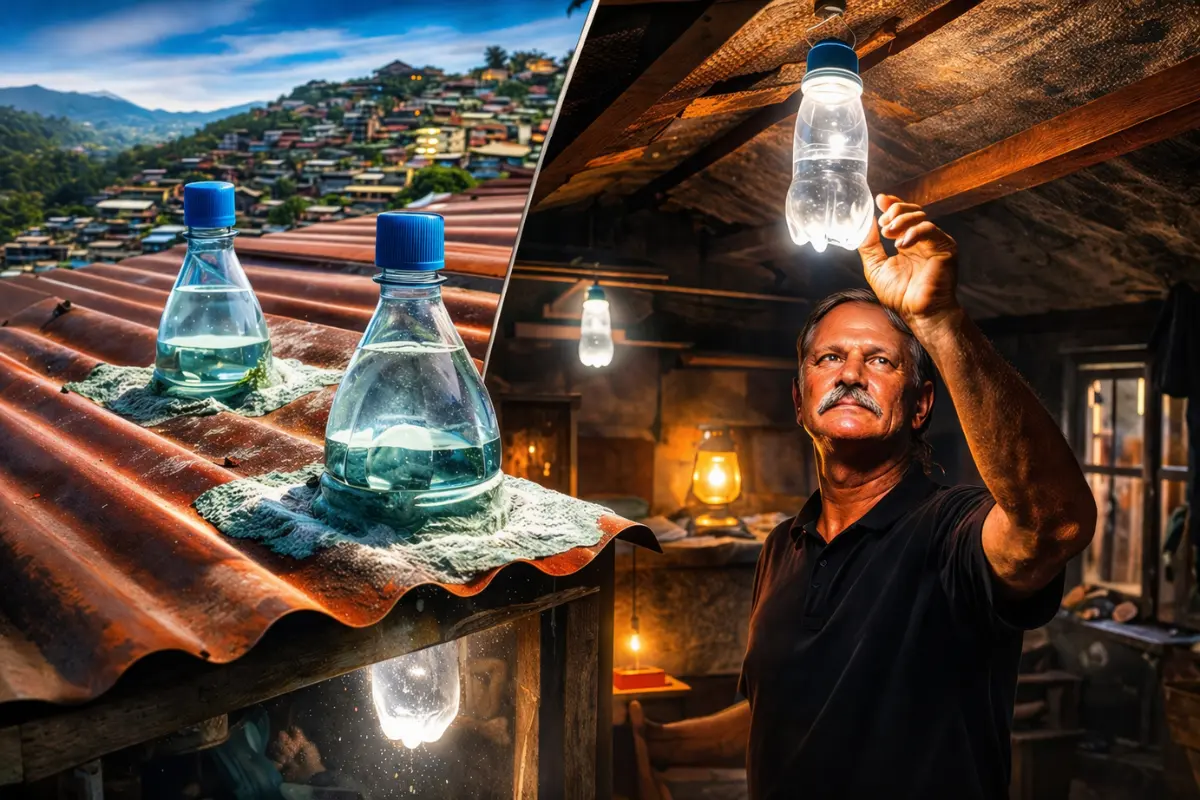
The moment the power cuts out, most homes go dark—but in some places, the solar bottle light turns that blackout into a room full of daylight.
In communities where electricity is unreliable or too expensive, a simple plastic bottle filled with water has become a working light source. It sounds like a trick. It isn’t. The idea, first used widely in Brazil, now lights up homes across Asia, Africa, and Latin America—without a single wire.
And for families dealing with daily outages or high energy bills, that changes everything.
The Surprising Fact Behind the Solar Bottle Light
A one-liter plastic bottle, filled with water and a small amount of bleach, can produce the same brightness as a 40 to 60-watt bulb—during the day.
No battery. No solar panel. No bill at the end of the month.
That matters most in places where people spend a large part of their income just to keep basic lights on, or where electricity simply doesn’t reach.
It’s not just about light. It’s about being able to cook, study, or work indoors without sitting in the dark.
What It Actually Is—and Why It Works
At its core, the solar bottle light is a daylight device installed through a roof.
Half of the bottle sits outside, exposed to sunlight. The other half hangs inside the home. When sunlight hits the water inside, it bends and spreads in all directions—a process called refraction. Instead of a single beam, the light fills the entire room.
The bleach keeps the water clear by stopping algae from growing, so the light stays bright for years.
There’s no switch.
No wiring.
No maintenance beyond making sure the bottle stays sealed.
It’s about as low-tech as it gets—and that’s exactly why it works in places where high-tech solutions fail.
How It Changed Daily Life for Thousands
In parts of the Philippines, entire neighborhoods have adopted the solar bottle light through the “Liter of Light” initiative. Volunteers teach families how to build and install them using basic tools.
The result is immediate.
Homes that were once dim during the day become bright enough for children to read and for adults to work indoors. Small shops can stay open longer. Indoor air improves because people no longer rely on candles or kerosene lamps.
One bottle. One roof.
That’s all it takes.
And at less than $1 per unit, the cost is often lower than a single day of electricity in some regions.
The Limits—and the Skepticism
The solar bottle light isn’t perfect.
It only works when the sun is out. At night, homes still need candles, batteries, or other sources of light. In areas with heavy cloud cover, brightness can vary.
There are also practical concerns. Poor installation can lead to leaks in metal roofs. Some early users had to adjust sealing methods to prevent rain from getting in.
Energy experts point out that while the idea is effective, it’s not a replacement for proper infrastructure. It doesn’t power appliances. It doesn’t store energy. It doesn’t solve long-term energy access on its own.
Still, for many families, it fills a gap that no large system has managed to solve quickly.
And it does it right now.
Why a Simple Idea Spread So Fast
Part of the reason the solar bottle light spread globally is because it doesn’t depend on supply chains or complex parts.
Anyone can build one with:
- A plastic bottle
- Clean water
- A small amount of bleach
- Basic tools to install it
That simplicity turned it into a community solution rather than a product.
Organizations like “Liter of Light” focused on teaching, not selling. That shift mattered. Instead of waiting for outside help, communities could fix their own problem in a single afternoon.
Online, the reaction has been consistent: people are struck by how something so basic can have such a big impact.
On platforms like YouTube and Reddit, the most common tone isn’t disbelief—it’s frustration.
Why isn’t something this simple more widely known?
Why are billion-dollar energy systems still out of reach for so many, when a $1 fix exists for at least part of the problem?
The Bigger Picture Behind the Idea
The solar bottle light sits at the center of a larger issue: energy inequality.
According to data from the International Energy Agency, hundreds of millions of people still lack reliable access to electricity. For them, lighting is not a given—it’s a daily challenge tied to cost, safety, and availability.
This is where low-cost solutions matter.
They don’t replace large systems. But they buy time. They reduce risk. They give people control over at least one part of their daily life.
And sometimes, that’s enough to make a real difference.
A Human Story That Keeps Repeating
The original idea came from a mechanic solving a local problem.
But the story didn’t stop there.
It repeats every time someone installs one of these lights for the first time. The same moment: cutting into the roof, placing the bottle, sealing it, then stepping back as sunlight fills the room.
No switch flipped.
No power restored.
Just light, where there wasn’t any before.
The Final Beat
For families using a solar bottle light, the question isn’t whether it’s advanced or permanent.
It’s simpler than that.
If a $1 fix can light up a room today, how long should anyone have to wait for something better tomorrow?