

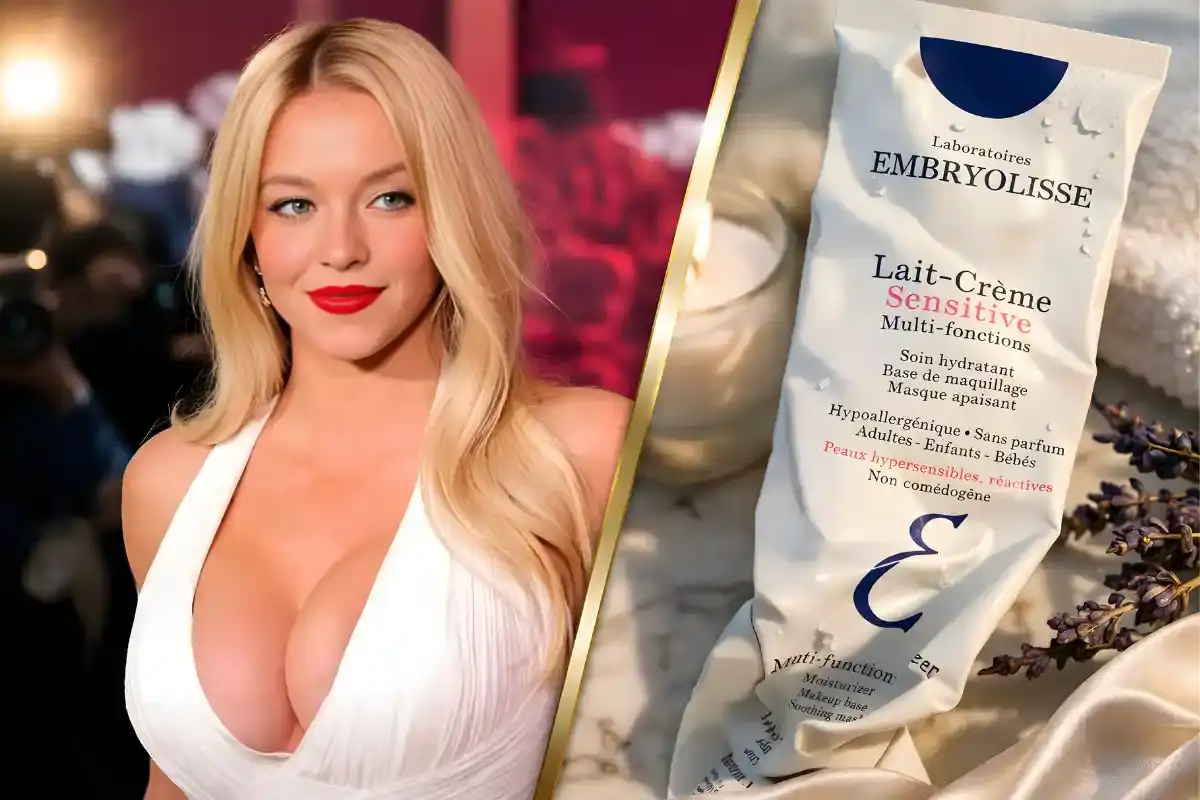
The kind of quiet envy that creeps in during a late-night scroll hit hard this time. Smooth skin, soft light, no heavy filters—just that effortless glow people chase for years. Then the name surfaced: Sydney Sweeney moisturizer.
It didn’t come from a luxury shelf or a $200 jar. It was a simple French cream, sitting in plain packaging, priced under $27. And suddenly, everyone wanted to know the same thing—how does a product this basic end up tied to one of Hollywood’s most photographed faces?
The Scene
Backstage lighting, soft glam, nothing loud—just a clean, polished look before cameras start flashing. That’s where the curiosity began. In beauty interviews and makeup artist breakdowns, Sydney Sweeney kept showing up with the same kind of skin: hydrated, calm, almost untouched.
Then her name started appearing next to a product makeup artists have used for decades—Embryolisse.
Not new. Not rare. Not expensive.
Just suddenly everywhere.
Who + Why Now
Sydney Sweeney has built a reputation that feels different from the typical celebrity skincare circuit. She doesn’t front a luxury beauty empire. She’s often described as low-key when it comes to routines—simple, practical, consistent.
That image matters.
Because right now, the beauty market is flooded with high-priced creams, influencer brands, and complicated routines. People are tired. They’re questioning what actually works.
So when her name gets linked to a $20-range moisturizer, it cuts through the noise.
At the same time, TikTok has been pushing a growing trend: “French pharmacy skincare.” Minimal branding. Long-standing formulas. No hype—until now.
The Full Story
The product at the center of this surge is Embryolisse Lait-Crème Sensitive, a fragrance-free version of a cream first created in 1950.
For years, it lived quietly in makeup kits. Professional artists used it as a prep step before foundation because it sits well on the skin—hydrating without turning greasy under lights.
That alone kept it relevant.
But it wasn’t viral.
What changed was timing.
Beauty creators began posting side-by-side comparisons: expensive creams versus this one. The results didn’t look wildly different. Sometimes, they looked the same.
Then media outlets picked it up. Headlines focused on the price. Under $27. That number kept repeating.
Search interest spiked.
Retailers reported quick sell-outs in some regions. Online listings fluctuated in price as demand jumped.
And people started testing it themselves.
Some expected a miracle. What they found was something simpler.
A thick, basic cream that works.
No dramatic scent. No flashy packaging. Just hydration, barrier support, and a texture that grips makeup well.
That’s it.
But in a market built on promises, “just works” is enough to feel surprising.
Public Reaction
On TikTok, the tone split almost immediately.
One side treated it like a discovery.
“Makeup looks better with this than my $80 cream.”
“I’ve used this for 10 years. Glad people finally caught on.”
Short clips showed smooth foundation application, dewy finishes, and routines stripped down to two or three steps.
The other side pushed back.
“It’s not magic. It’s just a moisturizer.”
“People acting like this is new is funny.”
A Reddit thread with hundreds of replies leaned even more blunt. Many users pointed out that Embryolisse has been a staple in Europe for decades. Some called the hype predictable—another cycle where an old product gets rediscovered once a celebrity name enters the conversation.
One comment summed it up in a way that kept getting repeated:
“Celebrities use normal products. The rest is marketing.”
Even comedians joined in on the tone. The joke wasn’t about the cream—it was about the industry. Expensive skincare brands charging premium prices while a basic formula gets the same results.
That contrast stuck.
Why This Keeps Happening
There’s a pattern here.
A product exists quietly for years. It works. Professionals trust it. Then a celebrity connection surfaces, even loosely, and everything changes.
The price becomes the headline.
Not because it’s high—but because it’s low.
According to data from Statista, the global skincare market continues to grow each year, with premium products driving much of that revenue. Yet at the same time, consumer behavior is shifting. More buyers are looking for “dermatologist-approved” basics instead of luxury branding.
That tension creates moments like this.
A $20 cream suddenly feels like a secret.
Even though it never was.
The Bigger Truth
This isn’t really about one product.
It’s about trust.
People don’t just want good skin. They want to believe they’re not being overcharged for it.
When a name like Sydney Sweeney is linked to something affordable, it feels like proof that simplicity still works.
Or at least that it might.
And that idea spreads faster than any marketing campaign.
Back to the Moment
That late-night scroll feeling doesn’t disappear easily. The comparison, the curiosity, the quiet question—what are they using that I’m not?
Now there’s an answer floating around, tied to a simple tube of cream and a familiar face.
But standing in front of the mirror, product in hand, the real question is harder to shake:
If something this basic works for them, what exactly have the rest of us been paying for?